


You step into the bathroom, glance down at the edge of the tub, and there it is.
That once-clean white bead of caulk has somehow become black, cracked, peeling, or all three. Not exactly the relaxing bathroom experience you had in mind.
For homeowners in Novi, Michigan, failing tub and shower caulk is an extremely common bathroom maintenance issue. Between daily shower moisture, limited ventilation, and Michigan winters when homes stay closed up for months at a time, bathrooms can spend a surprising amount of time damp. And caulk does not particularly enjoy being damp for a living.
Fortunately, black or separating shower caulk is usually a straightforward repair—provided you address the cause instead of simply putting another layer of caulk over the problem.
Why Does Shower Caulk Turn Black?
The most common reason is mold or mildew growth.
Bathrooms provide nearly everything mold wants: warmth, moisture, limited airflow, and small crevices where water can sit.
In Novi homes, the problem can be especially noticeable during colder months. Windows stay closed, indoor air circulation changes, and bathrooms may remain humid longer after showers.
Even caulk marketed as “mold resistant” is not mold-proof. Over time, soap residue, shampoo, body oils, and other materials collect along the caulk line and provide an inviting place for mildew to develop.
Those little black dots that appear along the edge of your tub aren’t necessarily evidence that your bathroom is falling apart. But they’re also not decorative.
Can Black Shower Caulk Be Cleaned?
Sometimes. If the mold is only sitting on the surface of the caulk, bathroom cleaners or mildew-removal products may improve the appearance significantly.
But once the discoloration penetrates into the caulk itself, cleaning often becomes a temporary cosmetic fix.
If you clean it and those black spots quickly return—or never completely disappear—the better solution is usually to remove the old caulk and replace it.
Why Does Caulk Pull Away From the Tub?
If your caulk is separating from the tub or shower surround, that’s usually more than a cleaning issue. It means the seal has begun to fail. There are several common reasons:
The Surface Wasn’t Properly Prepared
Good caulking starts long before anyone picks up the caulk gun.
Silicone does not adhere particularly well to:
- Old silicone residue
- Soap scum
- Cleaning-product residue
- Oils
- Mildew
- Damp surfaces
If new caulk was installed before the old material was completely removed and the surfaces were properly cleaned and dried, it may begin peeling surprisingly quickly.
This is one of the biggest differences between a quick “touch-up” and a proper tub re-caulking job.
The Wrong Type of Caulk Was Used
Not every tube of caulk at the hardware store belongs to your shower.
Painter’s caulk works wonderfully around interior trim, baseboards, and molding.
Around a bathtub? Not so much. Tub and shower joints require a flexible sealant designed for wet environments. A quality 100% silicone kitchen-and-bath sealant, or another product specifically approved for tubs and showers, is generally a much better choice.
It resists moisture and remains flexible as the tub and surrounding materials move slightly over time.
Your Bathtub Actually Moves More Than You Think
This surprises many homeowners. Fiberglass and acrylic bathtubs can flex slightly when someone steps into them or when the tub fills with water. It isn’t necessarily enough movement to notice. But the caulk notices. If the sealant isn’t flexible enough—or if it was poorly installed—that repeated movement can cause the bead to crack or pull away.
For some bathtub installations, professionals may even fill the tub with water before applying the final bead of sealant. The additional weight places the tub closer to its loaded position while the caulk cures. Think of it as tailoring the joint while the bathtub is actually wearing its work clothes.
The Gap May Be Too Large for Caulk Alone
Sometimes homeowners discover a fairly large gap between the bathtub and the wall or shower surround. The natural reaction is: more caulk.
Unfortunately, a giant blob of silicone isn’t necessarily a better seal.
Larger joints may require backer rod or another suitable backing material so the caulk maintains the proper depth and shape.
That allows the sealant to stretch and move properly rather than becoming one thick mass that eventually separates.
Could Water Be Getting Behind the Tub?
Yes. Once the caulk joint separates, shower water can travel behind the tub surround or into adjoining wall materials.
That does not automatically mean you have major water damage, but it does mean you should deal with the failed caulk rather than ignoring it.
Novi homeowners should watch for signs such as:
- Soft drywall next to the tub
- Bubbling or peeling paint
- Swollen baseboards
- Discolored trim
- Loose tile
- Musty odors
- Water stains on the ceiling below an upstairs bathroom
If you see those symptoms, simply replacing the visible caulk may not be enough. The surrounding area should be inspected before the joint is sealed again.
What Does a Proper Tub Re-Caulking Job Look Like?
For a typical bathtub or shower in a Novi home, a professional repair generally includes:
- Removing the existing caulk.
- Scraping away remaining silicone without damaging the tub or shower surround.
- Cleaning the joint to remove soap residue, mildew, and oils.
- Allowing the area to dry completely.
- Inspecting for gaps, movement, or signs of previous water intrusion.
- Installing backing material when necessary.
- Applying a quality bathroom-grade silicone sealant.
- Tooling the bead into a smooth, continuous joint.
- Allowing the silicone to cure properly before the shower is used again.
When the work is finished, your new caulk should be clean, smooth, watertight, and frankly, fairly uninteresting. That is exactly what you want. Nobody should walk into a bathroom and think, “Wow, check out that caulk.”
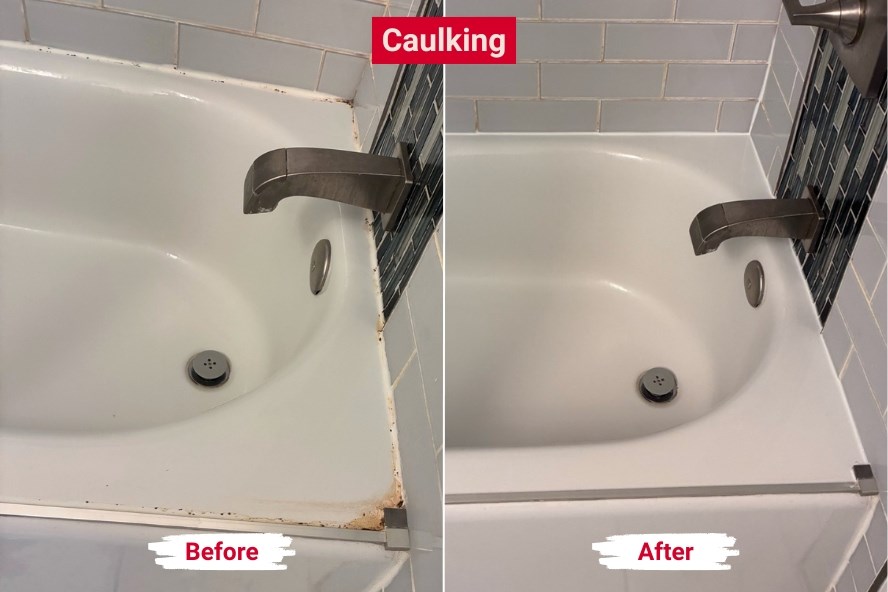
Before and after: Worn bathtub caulk removed and replaced with a fresh white seal by Ace Handyman Services West Oakland & Wayne Counties in Novi, MI.
How Can Novi Homeowners Keep Shower Caulk From Turning Black?
The biggest enemy is prolonged moisture. You don’t need to towel-dry the shower after every use like you’re detailing a Corvette, but helping the bathroom dry faster makes a big difference.
Use the bathroom exhaust fan while showering and continue running it afterward. Keep the shower curtain or door open when possible so moisture can escape. Periodically clean soap residue from the tub-to-wall joint.
And if your bathroom regularly stays foggy or humid long after the shower ends, it may be worth checking whether the exhaust fan is actually moving enough air—and whether it is properly vented outside.
A fan that makes noise but doesn’t remove moisture is basically just providing background music.
When Should Shower Caulk Be Replaced?
It’s probably time to re-caulk your tub or shower if you notice:
- Black staining embedded in the caulk
- Cracks
- Missing sections
- Separation from the tub
- Separation from the shower surround
- Repeated mildew that quickly returns
- Visible gaps where water can enter
Re-caulking is a relatively small home maintenance project. Ignoring a failed water seal can eventually become a much larger one.
For homeowners in Novi and the surrounding West Oakland County area, catching the problem early can help prevent moisture from reaching drywall, trim, flooring, or framing around the bathroom.
Need Help With a Tub or Shower Caulk Repair in Novi?
If your shower caulk has turned black, cracked, or started pulling away from the tub, Ace Handyman Services serving Novi, Michigan can remove the failed material, inspect the area, and install a clean new seal.
It’s one of those small repairs that can make a bathroom look noticeably better while also helping protect the materials behind it.
Because water belongs inside the bathtub. Once it starts exploring the rest of the house, things get expensive.