


The short answer: There’s no rule that your own balcony has to pass inspection before you can sell your condo. What changed is disclosure. Starting January 1, 2026, California condo sellers have to give buyers the HOA’s latest balcony inspection report, which associations must get every nine years under SB 326. If your building never had one done, that has to be disclosed too, and it can complicate a buyer’s loan. So check with your HOA before you list.
What is California’s condo balcony inspection law?
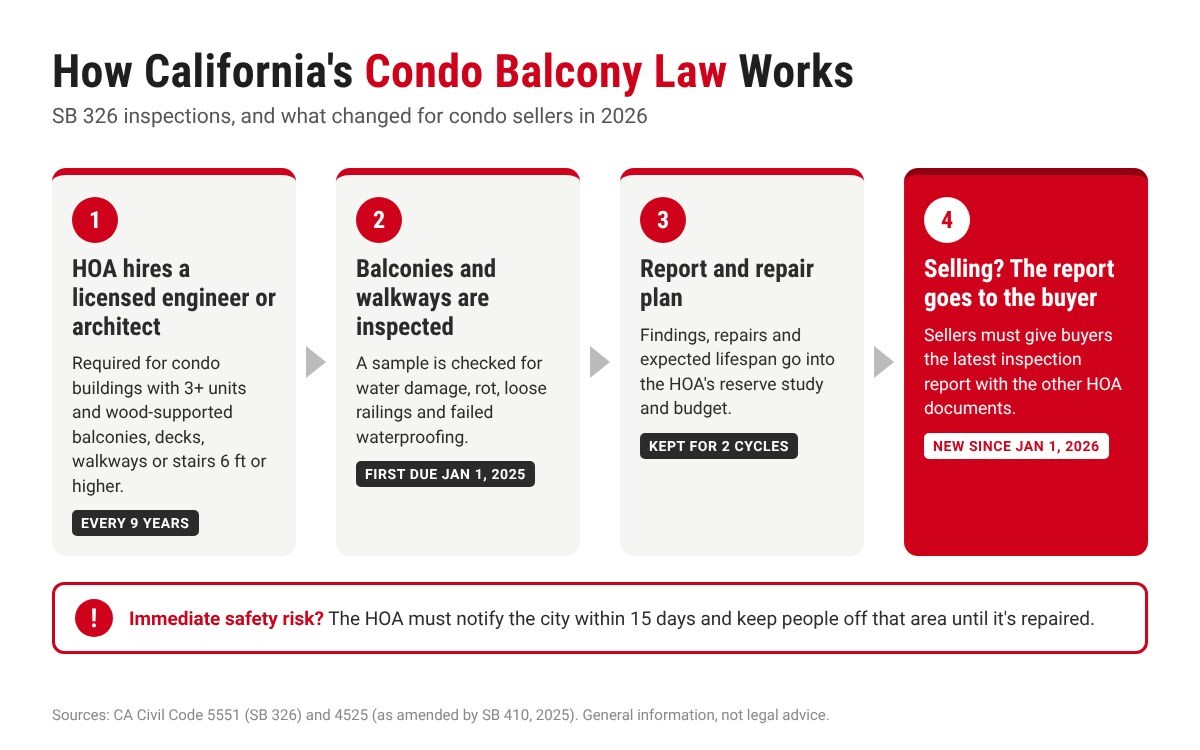
The rule comes from SB 326, a 2019 state law aimed at preventing balcony collapses like the one in Berkeley in 2015. It covers condo buildings with three or more attached units. It requires the homeowners association to hire a licensed structural engineer or architect to inspect the building’s “exterior elevated elements” at least once every nine years. Those are balconies, decks, walkways and stairways that are:
- At least six feet above the ground
- Built for people to walk or stand on
- Supported mostly by wood or wood-based framing
The first round of inspections was due January 1, 2025. The inspector checks a sample of the balconies and walkways, notes anything that needs repair and estimates how long each part will last. The report goes into the HOA’s reserve study, which is how the association plans and budgets for repairs.
If the inspector finds something that’s an immediate safety risk, the HOA must notify the city within 15 days and keep people off that area until it’s repaired.
What changed in 2026 for people selling a condo?
A newer law, SB 410, was signed in October 2025 and took effect January 1, 2026. It adds the latest SB 326 inspection report to the list of HOA documents a seller has to hand the buyer, along with the budget, CC&Rs and other disclosures.
The reason is financing. Lenders often want proof that a building has completed its balcony inspection, and sales have stalled when HOAs couldn’t produce one. Now buyers see the report as part of every condo sale, even when the inspection found nothing wrong.
Does the law apply to my building?
It depends on what kind of building you live in:
| Condos and HOAs (SB 326) | Apartments with 3+ units (SB 721) | |
|---|---|---|
| Who’s responsible | The HOA | The building owner |
| How often | Every 9 years | Every 6 years |
| First deadline | January 1, 2025 | January 1, 2026 |
| Who inspects | Licensed structural engineer or architect | Licensed engineer, architect, building inspector or qualified contractor |
| Report goes to buyers? | Yes, since January 1, 2026 | Kept on file for the city |
Not covered: single-family homes, and balconies built entirely of concrete or steel. The Westside has a lot of wood-framed condo and apartment buildings from the 1960s through the ’80s, in Santa Monica, Mar Vista, Palms and West LA. Many have exactly the kind of balconies and exterior stairs the law is about, and the marine layer keeps wood damp longer than it is inland.
What do balcony inspectors look for?
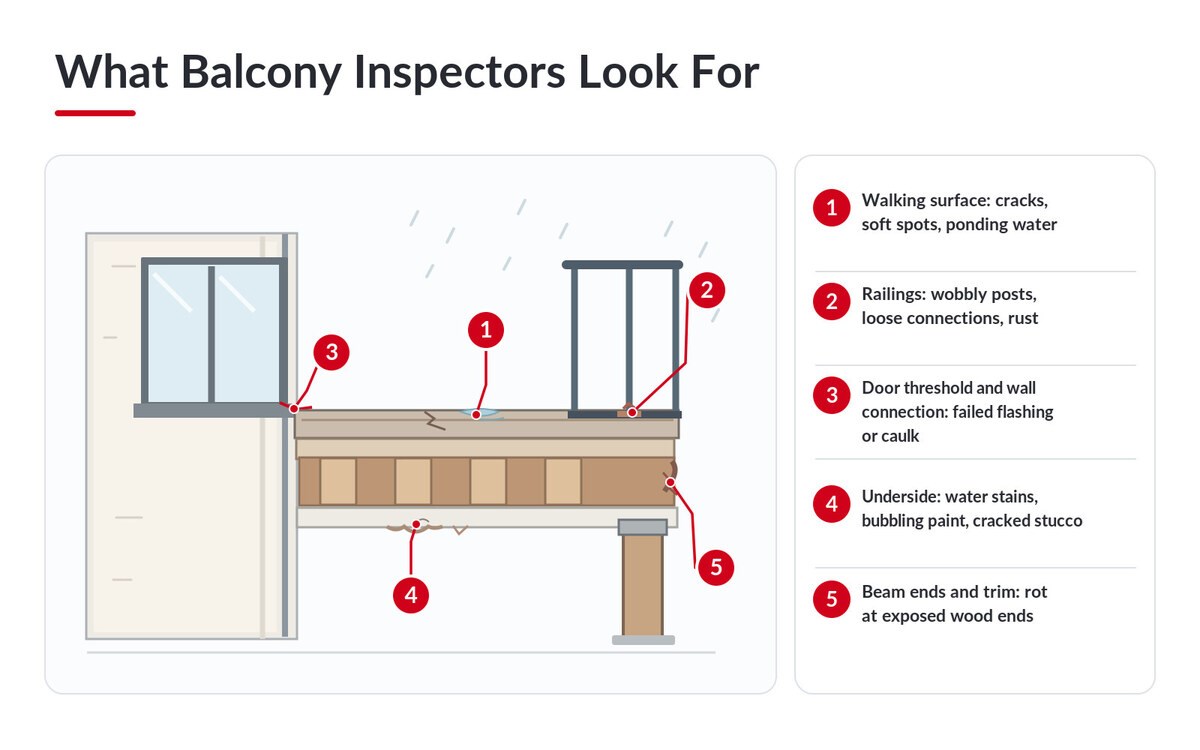
Water is the real enemy. Inspectors look for any sign that moisture has gotten past the surface and into the wood framing underneath. The usual suspects:
- The walking surface. Cracks, soft spots, ponding water or a worn waterproof coating
- Railings. Wobbly posts, loose connections and rust at the attachment points
- Where the balcony meets the building. Failed flashing or caulk at the door threshold and wall
- The underside. Stains, bubbling paint, cracked stucco or sagging soffits
- Wood ends and edges. Rot at beam ends, fascia and trim
Selling a condo soon? What to do now
- Request the inspection report before you list. Getting it during escrow can cause delays. If your HOA doesn’t have one, ask when it’s on the calendar.
- Read the recommendations. Find out which repairs the HOA has planned and whether a special assessment is coming.
- Know who handles what. In many associations, the HOA repairs the balcony structure while owners take care of everyday upkeep. Your CC&Rs spell this out.
- Take care of the small stuff on your side. Loose railings, worn caulk at the slider, peeling paint and stained ceilings below a balcony are easy for buyers to spot.
- Keep records of any work you’ve had done, with dates and photos.
Where a handyman can help (and where we can’t)
To be clear, we don’t do SB 326 or SB 721 inspections. The law requires a licensed engineer or architect, so start there. Structural balcony repairs may also need a permit and a specialty contractor.
Where we come in is the upkeep around it: tightening and repairing handrails and railings, re-caulking around sliding doors and thresholds, painting and staining, replacing rotted trim and deck boards, and fixing water-stained drywall below a balcony. If a job is outside what we do, we’ll point you to someone we trust.
Frequently Asked Questions
Do I need a balcony inspection to sell my condo in California?
Not personally. The inspection is the HOA’s responsibility, not the seller’s. But since January 1, 2026, sellers must give buyers a copy of the HOA’s most recent balcony inspection report, so ask your HOA for it before you list.
What is SB 326?
SB 326 is a California law that requires condo associations in buildings with three or more units to have their wood-supported balconies, decks, walkways and stairs inspected by a licensed engineer or architect at least every nine years. The first inspections were due January 1, 2025.
What’s the difference between SB 326 and SB 721?
SB 326 covers condos and HOAs, with inspections every nine years. SB 721 covers apartment buildings with three or more rental units, with inspections every six years. Both focus on balconies and walkways six feet or more off the ground that are supported by wood.
What happens if my HOA never did the balcony inspection?
The seller still has to disclose that there’s no report, and that can raise questions from buyers and lenders and slow down a sale. If you’re on the board or planning to sell, push for the inspection to get scheduled.
Does the balcony law apply to single-family homes?
No. SB 326 applies to condo buildings with three or more attached units, and SB 721 applies to apartment buildings with three or more units. A deck on a single-family home isn’t covered, though it’s still smart to check it for rot and loose railings.
Who pays for balcony repairs in a condo?
It depends on your CC&Rs. In many California associations, the HOA is responsible for repairing balconies and other common areas, while owners handle routine upkeep of areas they use exclusively. Check your governing documents or ask your HOA manager.
This article is general information, not legal advice. For questions about your building or your sale, talk to your HOA, real estate agent or attorney.
Getting your Westside condo ready to sell?
We’re your neighbors on the Westside, serving Santa Monica, Brentwood, Venice, Mar Vista and nearby neighborhoods. Our craftsmen are our own employees, background-checked and skilled across multiple trades. We’re licensed, insured and bonded, and every job comes with a one-year warranty. Seniors and veterans save 10% (restrictions may apply).
Call Ace Handyman Services Santa Monica at (424) 382-0923 or tap Get Started below to schedule your visit.