


On the first cold night of the season, a lot of Raleigh homeowners notice a chilly spot in the hallway right under the attic stairs. In summer, the same spot can feel warm. The cause is almost always the attic hatch: the panel and frame that close off your pull-down ladder or attic access. Most of the time it can be sealed and insulated rather than replaced. Here's how to tell what yours needs, and when it's time to call our attic ladder and attic stairs team.
Why is cold air coming from my attic stairs?
Your attic is close to outdoor temperature, and the hatch is a door in your ceiling that opens straight into it. In many Triangle homes it's also the weakest spot in the ceiling:
- Thin panel. Many builder-grade attic ladder doors are a single sheet of plywood with no insulation behind it.
- No seal. The gap between the door and its frame often has no weatherstripping at all, or the original strip has flattened and cracked.
- Gaps around the frame. The rough opening in the ceiling isn't always sealed, so air moves around the outside of the frame as well.
- A door that doesn't close flat. A warped panel or worn hinges leave a gap along one side.
Warm air rises, so in winter heated air slips out through the hatch into the attic. Cold air replaces it from elsewhere in the house, and you feel it as a draft.
How to find where the air is leaking
On a cold or windy day, try these quick checks:
- Hand test. Run the back of your hand slowly around the closed hatch. A cold line shows where the seal is missing.
- Light test. At night, turn on a light in the attic (or shine a flashlight down from the attic side) and look up from the hallway. Light around the panel means air can pass through too.
- Look at the panel. Check whether the door sits flat in its frame, or whether one corner hangs lower than the others.
- Check the strip. If there's weatherstripping, press it. Hard, flattened or cracked foam isn't sealing anymore.
“One of the most common causes of a drafty attic access is a warped or poorly fitting panel that no longer seals tightly against the frame. Aging or worn-out closing springs or pistons can also prevent attic ladders from closing securely, leaving gaps that allow conditioned air to escape. Many older attic ladders also lack proper insulation or weatherstripping, making them a significant source of energy loss in the home.”
Seal, insulate or replace: which does your hatch need?
Seal it: when the ladder is solid and the door closes flat
New weatherstripping around the frame, and sometimes adjusting the hinges so the door pulls up tight, stops most drafts. It's usually the quickest fix.
Insulate it: when the seal is fine but the panel is cold
An insulated cover (a box or tent that sits over the opening on the attic side) or rigid insulation fitted to the back of the panel keeps the hatch from acting like a cold plate in your ceiling. Combined with good weatherstripping, this handles most comfort complaints.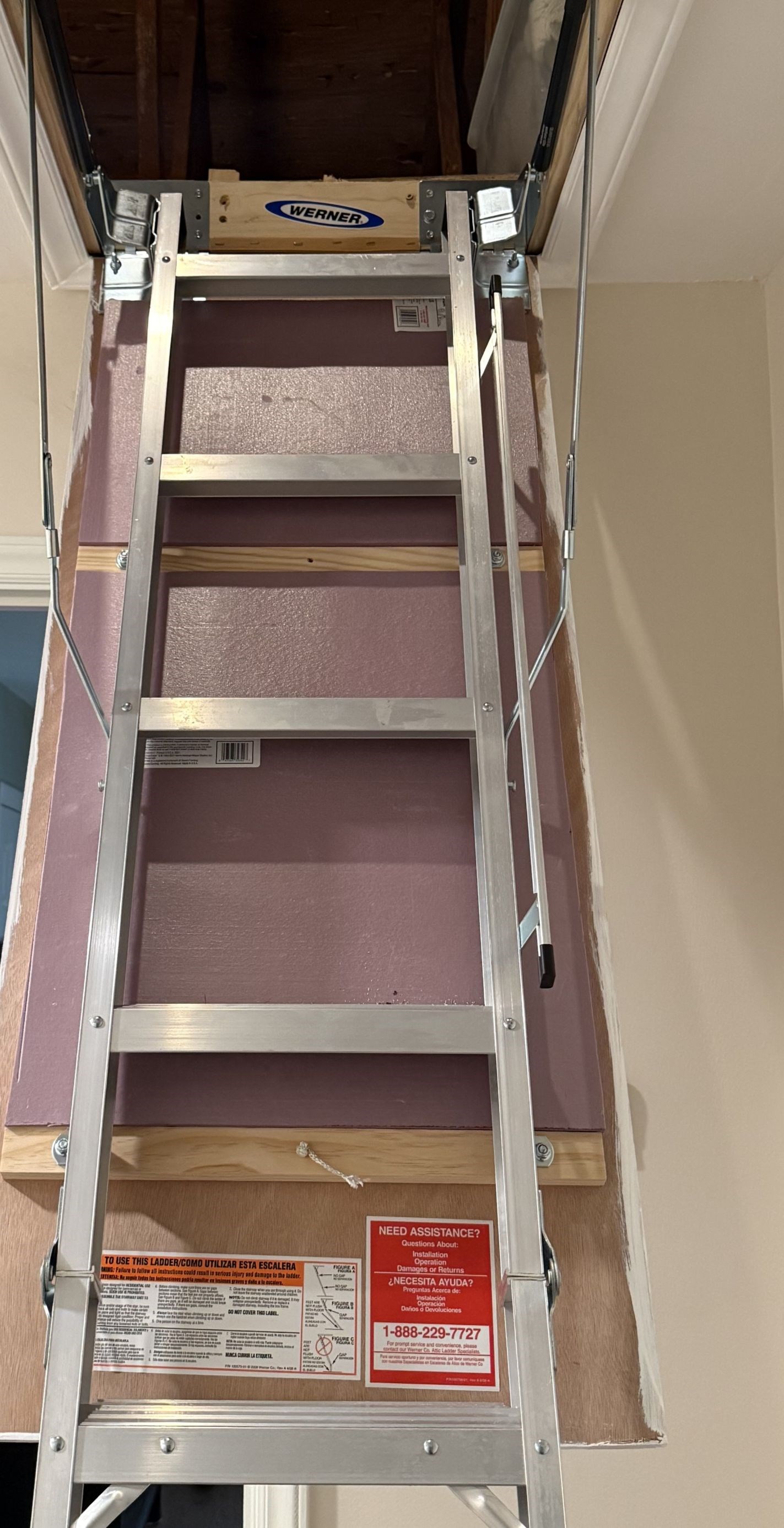 A pull-down attic ladder our team installed in Raleigh (27608) in July 2026. Rigid foam board on the back of the hatch door keeps attic heat and cold from coming through the panel.
Replace it: when the ladder itself is failing
If the panel is warped, the hinges or springs are worn, the steps flex, or the ladder doesn't land flat on the floor, sealing it rarely lasts. A new, properly fitted ladder solves the draft and the safety issue together. While you're checking, also confirm your ladder isn't part of the 2026 Louisville attic ladder recall.
Ann M., 5★, Sep 2024: "Dan was awesome. He arrived quickly and fixed our attic door. I appreciate him so much."
What about attic hatches without a ladder?
Many closets, bonus rooms and garages have a simple attic access panel (sometimes called a scuttle hole) instead of pull-down stairs. These leak air the same way. A panel that rests loosely on trim, with no seal and no insulation on top, is common. Weatherstripping the trim, adding insulation to the back of the panel and making sure it sits flat usually fixes it. If you'd rather have easy access, a basic hatch can often be enlarged and replaced with pull-down attic stairs where the framing allows.
Other winter drafts worth checking at the same time
If the attic hatch is drafty, other openings in the house usually are too. The most common are exterior doors, where worn seals or a sagging door leave gaps. Our guide on doors that won't latch or let in a draft covers those. Many homeowners have both fixed in one visit.
Who will come to your home
Every Ace Handyman Services craftsman is a background-checked, insured W-2 employee (not a subcontractor). Before your appointment, you'll get an on-my-way text with your craftsman's name and photo. Our work is backed by a one-year workmanship warranty, and projects of $2,000 or more may qualify for 0% financing for 6 months, subject to approval.
Frequently asked questions
How do I know if my attic hatch is leaking air?
Run the back of your hand around the closed hatch on a cold day, or look for light around the panel when the attic light is on. A cold line, visible light or a door that doesn't sit flat means air is passing through. Flattened or cracked weatherstripping is another clear sign.
Will an insulated cover make my attic ladder harder to use?
Not if it's fitted correctly. Most insulated covers sit on the attic side of the opening and lift off or open with the ladder. They add little effort when you go up. Your craftsman will make sure the ladder still folds, opens and closes smoothly after the cover is installed.
Can you seal a closet attic access panel that has no ladder?
Yes. We weatherstrip the trim the panel rests on, add insulation to the back of the panel and make sure it sits flat. If the panel is warped or broken, we replace it. Where the framing allows, we can also enlarge the opening and install pull-down attic stairs.
When is it worth replacing a drafty attic ladder instead of sealing it?
Replace it when the ladder itself is failing: the panel is warped, the hinges or springs are worn, the steps flex, or the legs don't sit flat on the floor. In those cases, sealing rarely lasts, and a new ladder fixes the draft and the safety problem at the same time.
Stop the draft before the coldest months
Call Ace Handyman Services Greater Triangle and Johnston County at (984) 319-0120 to have your attic hatch sealed, insulated or replaced.