


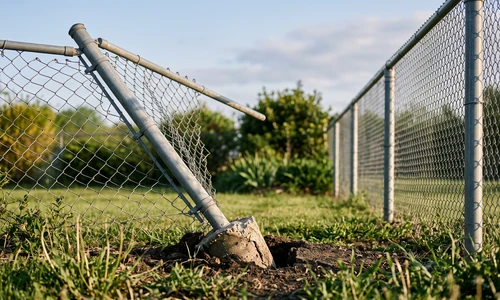
A leaning metal fence post rarely fixes itself, and waiting usually means the lean gets worse while rust or soil movement keeps working against the post. This guide walks through diagnosing why the post is leaning, three repair methods ranked by effort and permanence, and the specific signs that tell you when repair stops making sense and replacement takes over.
How do you fix a leaning fence post without removing it? You can stabilize a leaning metal fence post without full removal by bracing it with diagonal supports anchored into firm soil, or by installing a bolt-on support spur that transfers load to undisturbed ground below the frost line. Both methods work when the concrete footing is still sound and the post itself has not corroded through.
Some homeowners work through every step here and get a straight, stable fence by the weekend. Others get partway into excavation, find corrosion they did not expect, and decide the smarter move is to bring in fence installation and repair help rather than push forward with the wrong fix. Both paths are covered below.
Quick Overview: What Fixing a Leaning Metal Post Involves
- Diagnose whether the lean comes from post corrosion, footing failure, or connection damage
- Inspect the post base and concrete for rust, cracking, or movement
- Choose a repair path: concrete replacement, bracing, or a bolt-on support spur
- Gather corrosion-resistant fasteners and material specific to metal, not wood
- Excavate or brace, straighten the post to vertical, and secure the fix
- Cure concrete or tighten bolts on a schedule, then verify alignment
- Set up an annual inspection routine to catch corrosion before it spreads
Why Metal Fence Posts Fail Differently Than Wood
Metal fence post problems have almost nothing to do with the causes behind wooden fence failures. Wood leans because of rot, insect damage, or a fungus breaking down fiber at the ground line. Metal posts fail through oxidation: rust perforation at the base where moisture collects, corroded bolts at panel connections, and thermal expansion cycling that loosens the post-to-concrete bond over years of freeze-thaw movement.
Metal also conducts temperature differently than wood, which changes how concrete cures around it and how the post behaves seasonally. A steel post pulls heat out of fresh concrete faster than a wood post would, and repeated freeze-thaw cycles can crack a footing that was poured without accounting for that conductivity. Recognizing these differences up front keeps you from applying wood-fence logic to a problem that has a different root cause.
Diagnosing a Leaning Metal Post: Is It the Post or the Foundation?
Before you touch a tool, figure out what actually failed. A leaning metal post has three possible failure points: the post itself has corroded, the concrete footing has cracked or shifted, or the bolted connections between post and panel have degraded. Each points to a different repair.
Checking for Corrosion and Rust in the Post Base
Inspect the post at ground level and just below the soil line, where moisture sits longest. Look for rust staining bleeding into the surrounding concrete, flaking or bubbled paint, and any spot where a screwdriver tip pushes into the metal instead of scraping across the surface. A magnet run along the post can help you find weak spots that visual inspection misses. If you find perforation (a hole clean through the metal), that section of post is done. Repair will not restore structural strength; replacement is the only option.
Testing Concrete Integrity and Post-to-Concrete Bond
Probe the concrete footing itself with a screwdriver or masonry chisel. Sound concrete resists the probe; deteriorated concrete crumbles or flakes. Push against the post at ground level and watch whether it moves independently of the surrounding concrete. If the post rocks inside the footing while the concrete stays put, the bond has failed and you likely need Method 1. If the post and concrete move together as one leaning unit, the footing itself has shifted, which points toward bracing or a spur instead.
Method 1: Straightening Metal Posts by Replacing the Concrete Foundation
To straighten a leaning metal post by concrete replacement: excavate the old concrete around the post, clean rust from the post base, straighten the post to vertical using a level and temporary braces, pour rust-inhibiting concrete to a 24 to 30 inch depth, and cure for at least 48 hours. Replace the post outright if rust perforation is visible during excavation.
Excavating and Inspecting the Post During Repair
Dig a trench around the post wide enough to work in, staying clear of any panel bolts that might catch a shovel blade. As the old concrete breaks free, inspect the exposed post section closely. Surface rust with no pitting means you can proceed with repair. Any perforation or a post that bends rather than sits at a fixed lean angle means excavation has told you what you need to know: stop here and plan for replacement instead of continuing the repair.
Concrete Specifications for Metal Post Resets
Set the post in concrete to a depth of 24 to 30 inches, deeper than typical wood post specifications because metal's weight distribution and thermal behavior call for a more stable base. Use an air-entrained concrete mix, which resists cracking through freeze-thaw cycles better than standard mixes. Slope the concrete surface away from the post at the top, not just away from the fence line, so water does not pool against the metal and accelerate corrosion.
Method 2: Bracing a Metal Post Without Excavation
To brace a metal post without excavation: straighten the post using diagonal braces, secure the braces with stainless steel bolts at roughly 45-degree angles, drive ground stakes into firm soil, and tighten bolts weekly for the first month. This approach works well as temporary support while concrete cures, or as a longer-term fix when the concrete footing is sound and only the post connection has weakened.
How to stabilize a metal fence post? Stabilize a metal fence post by anchoring diagonal braces with corrosion-resistant bolts, driving support stakes into undisturbed soil past the shift line, and checking bolt tightness weekly. Avoid nails or standard steel fasteners against galvanized posts, since mismatched metals accelerate corrosion at the connection point.
Selecting Corrosion-Resistant Fasteners and Materials
Use stainless steel or hot-dip galvanized bolts wherever metal meets metal. If you brace with wooden stakes, choose pressure-treated or composite lumber so the stake does not rot and loosen its grip on the post within a season. Avoid aluminum hardware against steel posts; the two metals corrode rapidly where they touch due to galvanic reaction, undermining the very fix you just installed.
Safety Precautions When Working With Metal Posts and Fasteners
Metal post edges, especially at cut ends or old bolt holes, can be sharp enough to cut skin during handling. Wear gloves and safety glasses when driving bolts or tightening braces, and keep a firm grip on the wrench so it does not slip under torque. Wet metal can conduct electricity, so if your yard has buried lines near the fence line, confirm their location before driving stakes. These precautions matter more with metal than with wood, where the risks are mostly splinters and awkward lifting.
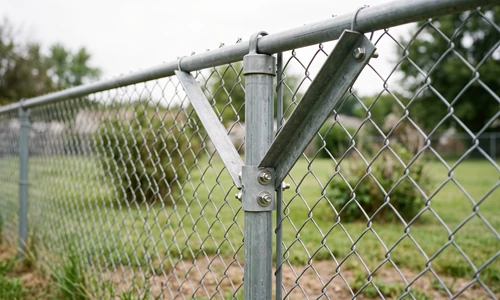
Method 3: Installing a Metal Support Spur for Long-Term Stability
A support spur is a pre-fabricated steel bracket that bolts to the existing post and extends underground into undisturbed soil, giving the post a new mechanical anchor point instead of relying on the original concrete to re-cure. Spurs work well when the existing concrete footing is sound but the post connection itself has weakened, or when soft soil conditions make a deep concrete pour impractical.
Sizing and Securing a Support Spur to Metal Posts
Match the spur size to your post diameter and the severity of the lean; a spur that is undersized will not correct significant lean angles. Use stainless or galvanized bolts and follow a tightening sequence that alternates sides, which keeps the post from bending as it is pulled toward vertical. Check vertical alignment with a level before the final bolt pass.
Choosing and Applying Corrosion-Resistant Fasteners and Coatings
Whichever method you choose, the fasteners and coatings you use during repair determine whether the fix lasts. Apply a rust-inhibiting primer to any exposed bare metal before it goes back into soil or concrete contact. Let primer cure fully per the product label before backfilling or pouring concrete over it; rushing this step traps moisture against unprotected metal and starts corrosion again almost immediately. Recheck all bolted connections after the first hard freeze-thaw cycle, since thermal movement can back off torque even on properly tightened hardware.
Bracing vs Full Concrete Replacement
Bracing is the lighter option, and it is the right call when the concrete footing tests solid and the lean is mild to moderate. Full concrete replacement is the right call when the post rocks independently of the footing, when the footing itself has cracked, or when you are already planning to reset multiple posts along the same fence line.
- Choose bracing when the footing is sound, the lean is under 10 to 15 degrees, and you want a same-day fix
- Choose bracing when you need a temporary hold while concrete elsewhere on the fence line cures
- Choose concrete replacement when the post moves independently of the concrete during your integrity test
- Choose concrete replacement when more than one post on the run shows the same failure pattern
Special Considerations for Older or Extensively Corroded Fence Runs
Fences installed decades ago often used posts and hardware that no longer meet current corrosion-resistance standards. If you are working on an older chain link fence leaning across several posts rather than just one, resist the urge to spot-fix each post individually. Widespread lean across a run usually points to a systemic issue: a footing depth that was too shallow for your region's frost line, or a batch of posts nearing the end of their service life together. In these cases, a full section reset delivers better long-term value than repeated single-post repairs. If the fence borders a property line, a pool safety barrier, or another feature where a failure carries real consequences, treat any doubt about structural integrity as a reason to bring in fence services for a full assessment before committing to a DIY repair path.
When to Replace Instead of Repair a Leaning Metal Post
Replace rather than repair when rust perforation covers more than roughly 20 percent of the post's circumference at any point. Replace when multiple bolts at panel connections are corroded through or missing entirely, since replacing hardware alone will not restore a compromised post. Replace when concrete failure affects multiple posts along the same run, which usually signals a structural issue with the original installation rather than isolated wear. Replace when the post is bent rather than simply leaning, which indicates impact damage that straightening cannot fully correct.
If your inspection turns up more than one of these signs, a professional evaluation through fence installation and repair services is worth the call before you spend a weekend on a fix that will not hold.
Preventing Future Rust and Post Failure
A repaired post is only as good as the maintenance that follows. Set a habit of inspecting bolts annually and retightening anything that has backed off from seasonal movement. Touch up any protective coating where bare metal has become exposed, since even small scratches become entry points for corrosion. Confirm that soil and mulch around the post base slope away rather than holding water against it, and check panel-to-post connections each spring for early signs of loosening.
Tools and Materials Needed for Metal Fence Post Repair
Other Materials You Will Need
- Post-hole digger or narrow shovel for excavation (Method 1)
- 4-foot level and a socket wrench set
- Air-entrained concrete mix (Method 1)
- Stainless steel or galvanized bolts, sized to post diameter
- Pressure-treated or composite lumber for temporary braces (Method 2)
- Pre-fabricated steel support spur sized to post diameter (Method 3)
- Rust-inhibiting primer for exposed bare metal
- Gloves and safety glasses
If gathering the right corrosion-resistant hardware and matching a spur to your exact post diameter feels like the part where a repair could go sideways, that scoping work is exactly where a fence installation and repair crew earns its keep.
Things to Consider Before You Start
- Have you confirmed the failure point? Bracing a post whose real problem is a cracked footing wastes a weekend on the wrong fix.
- Do you have the right fasteners on hand? Mismatched metals or standard hardware against galvanized posts will undo the repair within a season.
- Is more than one post affected? A single leaning post is a repair job; three or four leaning posts on the same run is a section-reset job.
- Does the fence guard something critical? Pool barriers and property-line fences deserve extra caution before you trust a DIY fix.
Once you have honest answers to those questions, you will know which side of the DIY line you are standing on.
Why Homeowners Bring in Ace Handyman Services
Even a straightforward-looking leaning post can turn into a bigger job once excavation reveals corrosion, a failed footing, or hardware that has degraded beyond a quick fix. That is when many homeowners reach out to Ace Handyman Services.
- Peace of mind on a fence line that protects a pool, a property boundary, or pets that cannot afford a failure
- A one-year labor warranty backing the repair, not just a handshake and a hope
- No need to source, learn to use, or return specialty tools like a post-hole digger or spur-tightening equipment
- Background-checked, multi-skilled W-2 craftsmen, not a rotating cast of unfamiliar contractors
- A predictable weekday timeline that does not eat your entire weekend
- Honest scoping that recommends bracing when bracing is enough, rather than upselling a full concrete replacement you do not need
- Cleanup included, so you are not left with excavated dirt and old concrete chunks in the yard
If your metal fence post repair has moved past what feels manageable solo, reach out to your local Ace Handyman Services office to get it handled right the first time.
Frequently Asked Questions
Can I use wooden braces with metal fence posts?
Yes, wooden braces work fine for temporary or long-term support as long as you use pressure-treated or composite lumber and fasten it with stainless steel or galvanized bolts. Standard steel fasteners or nails against a galvanized post can accelerate corrosion at the connection point over time.
How long does a metal post repair typically last?
A properly executed concrete replacement repair, using rust-inhibiting concrete and corrosion-resistant hardware, can last 15 to 20 years in most climates. Bracing or spur repairs last similarly long when fasteners are checked and retightened annually as part of routine maintenance.
What is the difference between a support spur and rebar reinforcement?
A support spur is a pre-fabricated steel bracket that bolts directly to the existing post and extends into undisturbed soil, offering a mechanical fix without a full concrete pour. Rebar reinforcement is a permanent addition embedded within a new concrete footing, requiring full excavation and a fresh pour rather than a bolt-on connection.
Do I need to remove the fence panels to fix a leaning post?
It depends on the method. Bracing and spur installation typically do not require panel removal since the work happens at the post itself. Concrete replacement may require detaching the adjacent panel sections temporarily so excavation equipment has room to work without damaging the connections.
How much does it cost to straighten a leaning fence post?
Material costs vary by method: bracing kits and hardware run on the lower end, while a full concrete replacement with a new post and rust-inhibiting mix costs more due to concrete volume and cure time. A support spur sits in between, since the bracket itself carries most of the material cost.
How do I know if a metal fence post is too damaged to repair?
Rust perforation through more than about 20 percent of the post's circumference, multiple corroded or missing connection bolts, or a bent (rather than leaning) post are all signs that repair will not hold. In these cases, replacement delivers a more reliable, longer-lasting result than continued patch repairs.