


Aluminum siding dents easily, scratches when a ladder brushes past it, and loosens from its locking channel after enough seasons of expansion and contraction. Fixing it is not complicated once you know what you are looking at, but it does demand the right tool for the right damage type. This guide walks through how to fix aluminum siding, panel by panel, so you can assess damage accurately, repair what is repairable, and recognize when a section has moved past DIY territory.
Can aluminum siding be repaired? Yes, in most cases. Loose panels, minor dents, scratches, small holes, and fading all respond well to targeted repair techniques. Panels with structural warping, deep corrosion, or multiple compounding damage types usually call for replacement instead of repair.
Some of these repairs are quick weekend work. Others, especially corner cap replacement near window and door penetrations, carry real water intrusion risk if done wrong. Ace Handyman Services is worth considering at any stage of this project, whether you want a second opinion on a damage assessment or you would rather hand the whole repair off to someone else.
Quick Overview: What Aluminum Siding Repair Actually Involves
Before you pull out a ladder, understand the shape of this project. Aluminum siding repair breaks into distinct tracks depending on damage type, and most homeowners deal with more than one at a time.
- Assessment (30-60 minutes): Walk the exterior, identify each damage type, and separate cosmetic issues from structural ones.
- Loose or detached panels: Reattach using a siding unlock tool, usually 20-30 minutes per panel once you understand the locking mechanism.
- Dents: Minor dents take 30-45 minutes each using a drill-and-pull method; larger dents mean panel replacement.
- Scratches and small holes: Clean, caulk, and color-match; 15-20 minutes per spot plus cure time.
- Fading: Full-panel or full-wall repainting with vinyl-based exterior paint; a half-day to a full weekend depending on square footage.
- Corner caps and trim: Nail extraction and reinstallation, higher stakes because of water intrusion risk near openings.
- Decision point: If a panel shows more than one failure type, or the siding is over 20 years old, weigh repair against replacement before investing labor.
Assessing Your Aluminum Siding Damage Before You Begin
Aluminum siding damage falls into a handful of recognizable categories, and matching the right fix to the right problem is the difference between a repair that holds and one that fails again within a season.
Identifying Damage Type
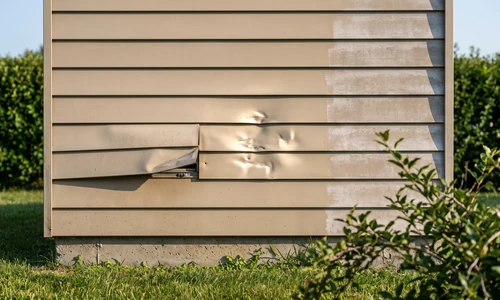
Loose panels flex when you push on them and often show a visible gap at the bottom lock. Dents range from shallow cosmetic dings to deep structural depressions that distort the panel profile. Scratches and small holes expose bare metal and invite corrosion if left untreated. Fading shows as a chalky, dulled surface, usually worse on sun-facing walls. Corner damage often appears as bent or detached caps at the building's vertical edges.
Self-Assessment Questions
Ask yourself three things before choosing a repair method. Does the panel flex or wobble when pressed, which points to a fastening problem rather than the panel itself? Is the damage isolated to one small area, or does it span the panel? And is this the first time this spot has failed, or has it been "fixed" before? Recurring failure at the same location usually means the underlying cause was never addressed.
Common Causes of Aluminum Siding Failure
Understanding why aluminum siding fails helps you evaluate whether a repair will actually hold. Installation errors are a frequent culprit: fasteners driven too tight restrict the panel's ability to expand and contract with temperature swings, and that stress eventually shows up as buckling or popped locks. Improper fastener spacing has a similar effect over time.
Environmental factors matter just as much. Aluminum expands and contracts more than some other siding materials across seasonal temperature swings, and repeated movement stresses joints and fasteners. Impact from debris, hail, lawn equipment, or ladders accounts for most dents and scratches. Age-related degradation, including fastener corrosion and coating breakdown, weakens the siding's ability to hold its shape and finish over decades.
Tying a repair back to its cause matters. A dent from a one-time impact is unlikely to recur once fixed. A dent from over-compression during original installation may reappear nearby even after you repair the visible one, because the underlying stress point has not changed.
Essential Equipment and Materials for Aluminum Siding Repair
The Siding Unlock Tool: Your Primary Investment
A siding unlock tool (sometimes called a zip tool) is the single piece of equipment that makes panel reattachment possible without damaging the interlocking channels. It slides along the panel seam to release the lower lock without prying or bending the aluminum. These run inexpensively at most hardware stores and are worth owning if you expect to maintain the siding over multiple years rather than renting one for a single repair.
Matching Materials to Repair Type
Different damage types call for different consumables, and using the wrong grade of material shortens the repair's lifespan. Exterior-grade caulk, not general-purpose caulk, is required for scratches and holes because it retains flexibility through temperature swings without cracking. For fading, vinyl-based exterior paint outperforms latex on aluminum because it adheres and flexes with the metal's thermal movement rather than sitting rigid on top of it.
Other Materials You Will Need
- Pry bar or flat-blade tool for corner cap and nail work
- Cordless drill with a small bit for the dent-pull method
- Sheet metal screws for temporary dent-pulling anchors
- Wire brush or fine sandpaper for surface prep before caulking or painting
- Color-matched touch-up paint or full-panel paint depending on scope
- Replacement corner caps and matching nails if trim is damaged
- Ladder rated for exterior work, plus stabilizers for uneven ground
If gathering the right tools and materials for a multi-panel repair feels like more logistics than you want to manage, a siding repair crew already carries the correct grades of everything on this list.
Step-by-Step Aluminum Siding Repair Process
Step 1: Reattaching Loose or Detached Panels
How to fix a loose piece of aluminum siding? Slide a siding unlock tool along the seam above the loose panel to release its lock, lift the panel gently outward, inspect the fastening strip for damage, re-nail if needed, then slide the tool along the bottom to re-engage the lock and press firmly until it clicks into place.
Start by locating the panel above the loose one, since aluminum siding locks into the panel below it along a horizontal channel. Work the unlock tool along that seam, pulling gently to release the interlock without bending either panel. Once released, swing the loose panel out and examine the nailing strip behind it. If nails have backed out or the strip has torn, address that before reinstalling, or the panel will loosen again within a season.
Step 2: Addressing Dents in Aluminum Panels
Minor cosmetic dents respond to the drill-and-pull technique. Drill a small pilot hole in the center of the dent, thread a sheet metal screw partway in, and pull outward with pliers or a slide hammer to draw the dent back toward its original profile, then patch the hole with caulk and touch-up paint.
This method works best on small, shallow dents on panels that are otherwise sound. It is labor-intensive and rarely produces a perfectly invisible repair, so set expectations accordingly. For larger or deeper dents, panel replacement is more practical and often faster than repeated pulling attempts. If the dent resulted from a one-time impact, such as a thrown object or hail, repairing it typically holds. If it resulted from installation stress like over-tightened fasteners compressing the panel, expect similar dents to appear nearby over time unless the fastening is corrected first.
Step 3: Repairing Scratches, Holes, and Fading
Scratches and small holes need a different approach than fading, even though both show up as visible surface flaws. For scratches and holes, clean the area thoroughly to remove dirt and oxidation, then apply exterior-grade caulk in thin layers, feathering the edges so the patch does not create a visible ridge. Color-match the finish once the caulk cures, typically within 24 hours depending on temperature and humidity.
For fading, caulk will not help. Fading is a coating issue, not a surface breach, and the fix is repainting with vinyl-based exterior paint rather than latex. Vinyl paint flexes with aluminum's thermal movement and resists chalking longer than latex formulations. Expect caulk repairs on scratches and holes to hold for roughly 2 to 3 years before touch-up is needed, while a properly applied vinyl paint job on faded panels typically maintains adhesion and color for 7 to 10 years.
Step 4: Replacing Damaged Corner Caps and Trim
Corner caps protect the vertical seams where siding panels meet, and they play a real role in keeping water out of the wall assembly, not just a cosmetic one. Start by extracting the nails holding the damaged cap in place, working carefully to avoid bending the adjacent panels. Select a replacement cap that matches the existing profile and color, position it over the corner, and re-nail using the original fastening pattern spacing.
Improper reinstallation here is one of the higher-risk mistakes in this entire project, because a poorly seated corner cap can channel water behind the siding rather than away from it, and that damage stays hidden until it shows up as rot or mold on the interior wall months later. This is a spot where professional installation is worth considering for protection, not just appearance.
Climate and Seasonal Considerations for Aluminum Siding Repairs
Application Windows and Cure Conditions
Caulk and paint both perform best within specific temperature ranges, generally 50 to 85 degrees Fahrenheit. Applying caulk in extreme heat causes it to skin over too fast and trap air, while cold application slows curing and weakens adhesion. Freeze-thaw cycles in cold climates can crack a caulk repair that was applied without accounting for the coming winter, since the material has not fully cured before contraction stresses it. High humidity slows paint curing and can cause a hazy finish.
Spot Repair vs. Full Panel Replacement
Can aluminum siding be detached and reset? Yes, individual panels can be unlocked, adjusted, or removed and reset using a siding unlock tool, provided the panel itself is not warped or corroded. If a panel resists reseating or won't hold its lock after correct reinstallation, that panel likely needs replacement rather than repeated resetting.
Spot repair makes sense when damage is isolated, recent, and confined to a small area of an otherwise sound panel. Full panel replacement becomes the better call once a single panel shows more than one type of damage, or once the repair has already failed once at the same spot.
- Spot repair is the right call when: damage is limited to one small area, the panel still seats and locks correctly, and the siding overall is under 20 years old.
- Full replacement is the right call when: multiple dents appear on the same panel, the panel shows structural warping that won't stay flat, there is visible rust or corrosion at the panel edges, or the siding has been in place for more than two decades.
Special Considerations for Challenging Aluminum Siding Repairs
Vintage aluminum siding from the 1960s through 1980s often carries an original painted finish that behaves differently under repair materials than modern factory finishes. Older painted surfaces may not accept vinyl paint as readily, and adhesion tests on a small hidden section before committing to a full repaint save wasted material and labor. Siding with widespread chalking across multiple walls, rather than isolated fading, often signals a coating failure that a single touch-up will not solve evenly.
Corrosion at fastener points, especially near ground level or under downspouts, indicates ongoing moisture exposure that a cosmetic repair will not resolve. Panels near window and door openings that show corner or trim damage carry elevated water intrusion risk, since these are already vulnerable penetration points in the wall assembly. When damage clusters in these areas, or when a previous repair has already failed, a exterior home repair professional can evaluate whether the issue extends behind the siding itself.
Repair Longevity and Maintenance Expectations
Aluminum siding itself is a durable material, but individual repairs are restoration points, not permanent fixes. Caulked scratches and small holes typically hold for 2 to 3 years before the caulk shows cracking or shrinkage and needs refreshing. Vinyl-based paint on faded panels generally maintains adhesion and color for 7 to 10 years under normal weather exposure. Reattached panels, once properly fastened, should hold indefinitely unless the underlying fastening issue recurs.
- Walk the exterior annually, ideally in spring, to catch new loosening or scratches early.
- Re-inspect caulked repairs every 2 to 3 years and plan to reapply before cracking allows moisture behind the panel.
- Check corner caps and trim after major storms, since these areas take the brunt of wind-driven debris.
- Do not treat a repair's eventual need for refreshing as a sign of failure; it is normal maintenance for exterior materials exposed to weather year-round.
Things to Consider Before You Start
Are you dealing with one damage type or several? A single loose panel is a straightforward weekend fix. A wall with loose panels, dents, and fading combined suggests deeper age-related wear that may be more efficient to address as a coordinated project.
- Is the damage isolated or repeated at the same spot? Recurring failure at one location means the underlying cause, not just the visible symptom, needs attention.
- Does the repair involve a corner cap or trim near a window or door? These carry higher water intrusion risk if reinstalled incorrectly.
- Is your siding older than 20 years? Material integrity and coating adhesion both decline with age, which affects how well new repairs will hold.
- Do you have the right materials on hand, not just similar ones? Exterior-grade caulk and vinyl-based paint behave differently than general-purpose versions, and substituting shortens repair life.
If your answers point toward multiple damage types, recurring failures, or work near vulnerable penetration points, that is the line where bringing in a professional starts to make more sense than pushing through solo.
Why Homeowners Bring in Ace Handyman Services
Some aluminum siding repairs are genuinely simple weekend work. Others carry real consequences if done wrong, particularly corner cap and trim work near windows and doors where a mistake stays hidden until water damage shows up months later.
- Peace of mind on repairs where a miscalculation could lead to hidden water intrusion behind the wall assembly.
- A one-year labor warranty backing the repair work, not just the materials.
- No need to source, learn, or return a siding unlock tool or dent-pull equipment for a one-time job.
- Background-checked, multi-skilled W-2 craftsmen rather than independently sourced labor.
- A predictable weekday timeline that does not eat into your weekend.
- Honest scoping: if your damage is a single loose panel, that is what gets addressed, not an upsold full re-side.
- Cleanup included, so you are not left with old caulk tubes, nails, and packaging after the work wraps.
If your assessment turned up damage that spans multiple panels, involves corner trim near an opening, or has already failed once before, reach out to your local Ace Handyman Services office to get a professional read on scope before you commit more time or material to a repair that might not hold.
Frequently Asked Questions
Can aluminum siding be repaired, or does damage always mean replacement?
Most damage types, including loose panels, minor dents, scratches, small holes, and fading, are repairable using standard techniques. Replacement becomes necessary when a panel shows multiple damage types at once, has structural warping, or shows corrosion at fastener points, since these conditions indicate the panel itself has failed rather than a surface issue.
Why is aluminum siding no longer commonly installed on new homes?
Aluminum siding fell out of favor primarily due to its tendency to dent easily compared to newer materials, along with fading and chalking issues on painted finishes over time. It remains a durable, long-lasting material on existing homes, and repair techniques for it are well established, but manufacturers shifted toward vinyl and fiber cement for new construction.
How long does a typical aluminum siding repair last before it needs attention again?
It depends on the repair type. Caulked scratches and holes generally hold for 2 to 3 years before showing cracking. Vinyl-based paint on faded panels typically lasts 7 to 10 years. Properly reattached panels with corrected fastening should hold indefinitely without further intervention.
What tools do I actually need to fix a loose aluminum siding panel?
A siding unlock tool is the essential item, since it releases the interlocking channel without bending the panel. You will also want a hammer or drill for re-nailing the fastening strip if it has pulled loose, and a ladder rated for exterior work if the damage is above ground level.
Can I paint over faded aluminum siding myself?
Yes, with the right preparation and material. Clean the surface thoroughly, address any chalking with a light sanding or deglossing step, and use vinyl-based exterior paint rather than latex, since vinyl formulations flex with the metal's thermal movement and hold color longer.
When does a dent in aluminum siding require full panel replacement instead of repair?
Shallow, isolated dents on an otherwise sound panel usually respond to the drill-and-pull repair method. Deep dents, dents that distort the panel's profile significantly, or multiple dents on the same panel are more practical to address through replacement, since repeated pulling attempts rarely restore a fully invisible finish at that scale.