


A sagging chain link fence or a mesh section crushed by a fallen branch does not automatically mean a full fence replacement. Most damage to a chain link fence falls into a handful of predictable categories, and most of those categories have a straightforward repair path that a patient homeowner can complete with basic hand tools.
Can a chain link fence be repaired? Yes, in most cases. Mesh separation, small holes, loose wire ties, and even bent or crushed sections are repairable with common tools and a few hours of work. Structural issues like leaning posts, undermined footings, or widespread rust are the exceptions that usually call for professional attention.
Some homeowners get partway through a repair and realize the post is more compromised than it looked, or the mesh has stretched beyond what a fence stretcher can fix. Ace Handyman Services is an option at any stage of the process, whether you want a second opinion on a diagnosis or you want the whole repair handled from start to finish.
Quick Overview: What Chain Link Fence Repair Actually Involves
Before you buy a single tool, it helps to know what the full arc of a repair project looks like. Here is the stage-by-stage breakdown:
- Walk the fence line and identify every damaged section, not just the obvious one
- Classify each damage type: mesh separation, bent or crushed mesh, rust, or post/structural failure
- Decide which sections are DIY-repairable and which need professional evaluation
- Gather tools: pliers, wire cutters, and a fence stretcher if you are dealing with bent or replacement sections
- Source replacement mesh, tension wire, or hardware sized to match your existing fence
- Remove damaged material, working outward from the worst point until you hit solid mesh
- Install and tension the new section, re-securing to top rail and posts with wire ties
- Inspect the whole fence line for smaller issues you can fix while you are already out there
- Set a seasonal inspection habit so small issues get caught before they become full sections
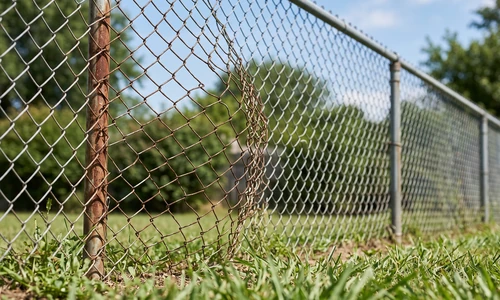
Assessing Your Chain Link Fence Before You Begin
What are common chain link fence problems? The most frequent issues are separated mesh at seams, bent or crushed sections from impact, loose or missing wire ties, rust at cut edges and ground contact points, and post movement from frost heave, rot, or vehicle impact. Each type has a different repair path and a different level of difficulty.
Mesh Separation and Small Holes
Mesh separation happens where two rolls of fabric meet, or where a knuckle joint has worked loose over time. This is the easiest damage type to fix and requires only pliers and a length of matching wire. If you can wiggle two mesh edges apart with your hands, this is your repair category.
Crushed or Bent Sections
A crushed section, often from a fallen branch, a vehicle backing into the line, or storm debris, looks dramatic but is frequently repairable. The distinction from mesh separation is that the diamond pattern itself has deformed rather than just pulled apart at a seam. Straightening bent mesh back into a true diamond pattern usually requires a fence stretcher to reapply even tension across the width of the section.
Post Damage and Structural Failure
A leaning post, a post that wobbles at the base, or a section of fence that is visibly pulling away from its footing signals structural failure rather than mesh damage. This is where the DIY line gets drawn. Reset posts, cracked concrete footings, and undermined sections from erosion or burrowing animals usually exceed what hand tools and patience can fix safely.
Essential Equipment and Materials for Chain Link Fence Repair
What tools do you actually need to repair a chain link fence? A pair of fence pliers, standard wire cutters, and work gloves cover the vast majority of repairs. A fence stretcher becomes necessary only when you are straightening bent mesh or hanging a new section, and it is worth renting rather than buying for a single project.
Hand Tools for Basic Repairs
Fence pliers (sometimes sold as combination fence tools) handle cutting, twisting, and crimping wire ties in one tool. Standard side-cutting pliers work as a substitute if you do not want to buy a specialty tool for a one-time fix. Add a pair of heavy leather work gloves; chain link wire ends are sharp enough to open skin quickly, and you will be handling a lot of it.
Specialized Tools: Rent or Own the Fence Stretcher
A fence stretcher (also called a come-along or ratchet-style tensioner) pulls slack mesh tight before it is tied off to the terminal post. If you are only fixing one bent section, most equipment rental centers carry these by the day, and renting is the more practical call.
Other Materials You Will Need
- Replacement chain link mesh, sized to match gauge and diamond pattern of the existing fence
- Tie wire or pre-cut aluminum wire ties in a matching gauge
- Tension bar (a flat metal bar threaded through the mesh end to attach at terminal posts)
- Tension wire if your fence uses a bottom tension wire instead of a bottom rail
- Wire brush and rust-inhibiting primer for cut edges and repaired sections
If sourcing the right gauge mesh or figuring out post hardware compatibility is where the project starts to feel like guesswork, a fence installation and repair crew can shortcut that research and make sure the materials match what is already on your property.
Step-by-Step Chain Link Fence Repair Process
How to fix chain link mesh? Isolate the damaged section, cut and remove it back to solid mesh on both sides, cut a replacement patch to size, weave it into the existing mesh diamond by diamond, and secure it with wire ties to the top rail and any adjacent posts. Most mesh repairs of this scope take two to four hours.
Step 1: Isolate and Remove the Damaged Section
Work outward from the worst point until you reach undamaged mesh. Untwist or cut the wire ties holding the damaged section to the top rail and terminal posts. Using your pliers, unwind the knuckle at the top and bottom of the vertical wire strand marking the edge of your repair zone, then pull that strand free to separate the old section from the good mesh on either side.
Step 2: Cut and Size the Replacement Mesh
Measure twice before you cut once, matching diamond count to diamond count. Unroll your replacement mesh next to the opening and count diamonds across the width and down the height so the new patch aligns with the existing pattern. Cut the replacement piece by unwinding a vertical strand rather than cutting straight through wire, which leaves a clean edge for reweaving.
Step 3: Weave and Rejoin the Mesh
Reintroduce the loose vertical strand as a hinge that laces the two sections together. Thread the freed vertical wire strand back down through the diamonds of both the old and new sections, alternating over and under, until the two pieces of mesh are knitted into one continuous pattern. This is the slowest step in the process, and rushing it is what causes gaps to reopen within a season.
Step 4: Tension and Secure the Section
A properly tensioned fence should have no visible sag or wave when viewed down the fence line. If you are working a wide replacement, attach the fence stretcher to the terminal post and the tension bar on the loose end of the new mesh, then ratchet until the diamonds pull into a tight, even pattern. Tie the top of the mesh to the top rail every 12 to 15 inches with wire ties, twisting each tie tight with pliers and trimming the excess tail.
Step 5: Replace Loose or Missing Wire Ties
While you have your pliers out, walk the full fence length and replace any wire ties that are rusted, loose, or missing. This is the single most overlooked maintenance task and the cheapest insurance against future mesh separation.
Choosing and Applying Rust Protection After Repair
Application and Cure Time for Rust-Inhibiting Primer
Any cut edge on chain link mesh is bare metal and will start rusting within weeks if left untreated. Brush a rust-inhibiting metal primer onto every cut end and any exposed galvanized coating you scratched during the repair. Most primers need 24 hours of dry weather to cure fully before they are rain-ready, so plan the repair around a dry forecast window when possible.
Spot Patching vs Full Section Replacement
Not every damaged area needs the full removal-and-reweave process described above. A spot patch, where you simply wire a small piece of mesh over a hole without removing the surrounding damaged fabric, is faster but less durable.
- Spot patch when: the hole is small, isolated, and in a low-visibility or low-stress area of the fence line
- Spot patch when: you need a temporary fix to contain pets or secure a property line before a full repair can be scheduled
- Full replacement is the right call when: the damage spans more than a few feet, involves bent structural framework, or sits at a load-bearing point like a gate post
- Full replacement is the right call when: the surrounding mesh shows rust or fatigue that will likely fail again within a year or two
Special Considerations for Older or Compromised Fences
How to fix a falling chain link fence? A fence that is visibly falling or leaning usually points to a post problem rather than a mesh problem. Check whether the post itself has shifted at ground level or the concrete footing has cracked. Reset the post plumb, repour the footing if it is compromised, and only then address any mesh damage caused by the lean.
Fences installed decades ago often use hardware sizes or mesh gauges that are no longer standard, which can make sourcing an exact match difficult. Galvanized coatings also degrade unevenly over time, so a repair that looks fine on day one can rust faster than the surrounding original fence.
Maintenance and Long-Term Care
A seasonal walk-through catches most chain link fence problems while they are still cheap, quick fixes. Spring is the time to check for frost heave and post settling after winter freeze-thaw cycles. Summer inspections should watch for UV-related brittleness in vinyl-coated mesh and any digging damage from pets or wildlife at the base of the fence. Fall is when debris accumulation and early rust spots show up, and winter is when salt exposure near roads or walkways accelerates corrosion.
- Rinse road salt and debris off the fence line each spring in areas with winter salt use
- Touch up rust spots with primer as soon as you spot them rather than waiting for a full repair cycle
- Keep vegetation and vines cleared from the mesh, since plant growth traps moisture against the wire
- Check tension along long runs annually; mesh naturally loosens over years of thermal expansion and contraction
Things to Consider Before You Start
- Do you have a dry stretch of days ahead? Rust primer and tensioning work both go better without rain interrupting the process.
- Is the damage isolated, or does it point to a bigger structural issue? A bent section next to a leaning post is a different project than a bent section on an otherwise solid line.
- Can you source mesh that matches your existing gauge and coating? Mismatched mesh is a visible and functional weak point.
- Are you comfortable working with a fence stretcher under tension? The tool stores real force, and releasing it carelessly can cause injury.
If your honest answers put you on the confident side of these questions, the repair is well within DIY reach. If they raise more questions than they answer, that is the signal to bring in a professional before you spend a weekend on a fix that will not hold.
Why Homeowners Bring in Ace Handyman Services
Even straightforward-looking fence repairs can turn into bigger projects once you are elbow-deep in rusted hardware or a post that will not come loose. Here is why homeowners often bring in outside help partway through, or from the start:
- Peace of mind when the fence marks a property line, secures a pool, or contains pets, where a failed repair carries real consequences
- A one-year labor warranty on completed repair work
- No need to source, learn, or return a fence stretcher and specialty tools you may only use once
- Background-checked, multi-skilled W-2 craftsmen rather than a rotating cast of subcontractors
- A predictable weekday timeline that does not eat into your weekend
- Honest scope assessment, including when a spot patch is genuinely the better call over a full section replacement
- Cleanup included, so old mesh, wire scraps, and packaging do not become your problem after the work is done
If a damage assessment on your own fence line raises more questions than it answers, reach out to your local Ace Handyman Services office to get an experienced set of eyes on the project before you commit to tools and materials.
Frequently Asked Questions
Can a chain link fence be repaired instead of replaced?
Yes, in the majority of cases. Mesh separation, small holes, bent sections, and loose ties are all repairable. Full replacement usually only becomes necessary when posts have failed structurally or rust has compromised large stretches of the fence line.
What causes the most common chain link fence failures?
Impact damage from fallen branches, vehicles, or lawn equipment causes most bent and crushed sections. Rust at cut edges and ground contact points causes gradual mesh failure over years, and frost heave or poor original installation causes most post movement.
Can I repair a chain link fence in cold or wet weather?
Mesh repair itself is not weather-dependent, but rust primer needs dry conditions to cure properly, and frozen ground makes resetting a post footing impractical. Plan post repairs for a season when you can dig and pour concrete, and save mesh-only repairs for whenever you have a dry afternoon.
How much does a fence stretcher cost to rent?
Daily rental rates for a fence stretcher are typically modest compared to a purchase price, making rental the practical choice for a single repair. If you expect repeat repairs across a long fence line, purchasing a mid-grade unit becomes cost-effective after just a couple of projects.
How can I tell if chain link fence damage needs a professional?
Leaning or wobbling posts, cracked concrete footings, undermined sections from erosion, and rust that has spread through large sections of mesh are all signs that the repair has moved beyond typical DIY scope. If you are unsure, a professional assessment before you start is cheaper than a redo.
Should I patch a small hole or replace the whole section?
A spot patch works fine for small, isolated damage in low-stress areas of the fence. Replace the full section when damage spans several feet, sits at a gate or corner post, or when surrounding mesh already shows rust and fatigue likely to fail again soon.