


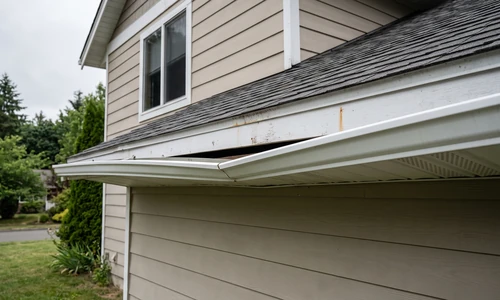
A gutter pulling away from the fascia is one of those problems that looks minor until it isn't. A two-inch gap today can mean water running behind the fascia board, soaking into the rim joist, and turning a weekend fastener job into a structural repair. This guide walks you through diagnosing the problem correctly, choosing the right fastening method, and completing a repair that actually holds instead of separating again next season. **Can gutters be reattached, or do they need full replacement?** Most gutters pulling away from the house can be reattached successfully if the fascia board underneath is sound and the gutter material itself is not corroded or cracked. The repair becomes a replacement scenario only when the fascia is rotted through, the gutter has multiple failure points, or the metal itself has deteriorated. Ace Handyman Services is an option at any stage of this project, whether you want a second opinion on fascia condition before you start or you would rather hand off the ladder work altogether.
Quick Overview: What Fixing a Detached Gutter Actually Involves
Here is the stage-by-stage breakdown of a proper gutter reattachment, from first inspection through final testing:
- Clear all debris from the gutter channel so you can see the actual attachment points and fascia condition
- Inspect the fascia board for soft spots, discoloration, and rot using a visual and tactile check
- Remove the old fasteners and examine the holes they left behind for wallowing or splitting
- Choose a fastening method: gutter spikes, brackets, or hidden hangers, based on longevity needs
- Install new fasteners at proper spacing, typically 24 to 36 inches apart
- Correct the gutter pitch so it slopes about 1/4 inch per 10 feet toward the downspout
- Test the repair with a visual check after 24 hours and a water test using a garden hose
- Set a maintenance schedule so debris load and fastener wear do not cause a repeat failure
Assessing Gutter Pulling Away From House Before You Begin
Sudden Separation vs. Gradual Loosening
Gutters do not all fail the same way. A gutter that comes loose overnight, especially after a storm or heavy debris load, usually means a fastener sheared under sudden weight. That is closer to an emergency because the remaining fasteners are likely carrying more load than they were designed for. A gutter that has been drifting away gradually over months is more often fastener creep from corrosion or repeated freeze-thaw cycling. Both need repair, but the sudden case deserves faster attention since nearby fasteners may already be compromised.
Pre-Work Checks and Measurements
Before you touch a fastener, walk the full run of the gutter and note where gaps appear, how wide they are, and whether the sag is isolated to one section or spread across the whole run. Multiple separation points along the same run often point to a systemic problem, either widespread fascia rot or an original installation that used the wrong fastener spacing. Measure the gap width at its worst point. A gap under an inch is usually straightforward reattachment.
Essential Equipment and Materials for Gutter Reattachment
Choosing Your Fastening Method
You have three realistic options for reattaching a gutter, and they are not interchangeable in terms of durability. Gutter spikes, the long nails driven through the gutter and into the fascia, are the fastest to install but also the weakest long-term choice; they tend to work loose again within three to five years under normal load. Brackets distribute weight across a wider surface and typically hold for seven to ten years. Hidden hangers, which screw into the fascia and tie into the rafter tail behind it, provide the strongest connection because they anchor into solid framing rather than just the fascia board's face.
Consumables and Fastener Selection
Whatever method you choose, use stainless steel or galvanized fasteners. Standard uncoated steel corrodes faster in the wet environment gutters create, which is part of why some original installations failed in the first place. Match fastener length to your fascia thickness so the tip reaches solid wood without punching through the far side.
Other Materials You Will Need
- Hidden hangers, brackets, or gutter spikes (stainless steel or galvanized)
- Cordless drill with a driver bit matched to your fastener heads
- 4-foot level and a tape measure
- Sturdy extension ladder rated for your height requirement, with a stabilizer if working near a fascia edge
- Wood hardener or epoxy filler if fascia shows minor surface softness
- Work gloves and safety glasses
- Garden hose for post-repair testing
If scoping the equipment and figuring out which fastening method your gutter actually needs is the part where the wheels could come off, an gutter repair professional can assess the fascia and hardware in one visit and save you a return trip to the hardware store.
Step-by-Step Gutter Reattachment Process
Step 1: Clear the Gutter Channel Completely
You cannot assess a gutter problem you cannot see. Remove leaves, pine needles, shingle grit, and standing debris from the entire run before you inspect anything. A clogged gutter can hold well over 500 pounds of waterlogged debris, and that weight is exactly why fasteners spaced 36 inches apart can end up carrying far more load per fastener than they were designed to handle. Clearing the channel also lets you see the true position of the gutter against the fascia rather than a position distorted by trapped weight.
Step 2: Inspect Fascia Board Health
What does normal fascia condition look like versus a failure condition? Sound fascia feels solid when you press a screwdriver against it and shows no discoloration or peeling paint at the point of contact. Failing fascia gives under light pressure, may show dark staining or a chalky texture, and often smells faintly musty. If the screwdriver sinks in more than about a quarter inch, or the soft area is larger than a thumbnail, fastening into that spot will not hold regardless of which hanger type you use.
Look closely at discoloration patterns, since staining that runs vertically down the fascia often traces the exact path water has been taking behind the gutter. Press firmly along the full length of the board, not just where the gutter has separated, since rot can spread beyond the visible gap. If the wood is only mildly discolored and firm to the touch, a wood hardener can restore enough structural integrity for fasteners to grip. If it is soft and crumbling, that section of fascia needs to be cut out and replaced with new lumber before any fastener goes back in.
Step 3: Remove Old Fasteners and Inspect the Holes
Pull the old spikes, brackets, or hangers and look at the holes they leave behind. A clean, tight hole in solid wood can sometimes be reused with a slightly larger fastener. A wallowed-out or splitting hole should be avoided; offset your new fastener position by an inch or two so it bites into undisturbed wood rather than repeating the failure point.
Step 4: Install New Fasteners at Proper Spacing
Space fasteners 24 to 36 inches apart along the gutter run, tightening the spacing toward 24 inches in regions with heavy snow load or in sections that carry more runoff, such as near valleys or long roof planes. If you are using hidden hangers, make sure each one catches the rafter tail behind the fascia rather than just the face of the fascia board itself; that rafter tie-in is what gives hidden hangers their extended lifespan compared to brackets or spikes.
Step 5: Correct the Gutter Pitch
Reattachment is your opportunity to fix a slope problem that may have contributed to the original separation. A gutter with the wrong pitch collects standing water, adding weight that stresses fasteners even when debris is cleared regularly, and it also puts uneven pressure on the downspout connection.
Choosing and Applying the Right Gutter Pitch
Adjusting Gutter Pitch During Reattachment
Use a level and tape measure to check for roughly 1/4 inch of drop for every 10 feet of gutter run, sloping toward the downspout. If the gutter currently sits flat or slopes the wrong direction, loosen the fasteners near the high point and gently shim or bend the gutter to restore the correct angle as you refasten. Severely corroded gutter material may not tolerate this adjustment without deforming or cracking, which is a sign the gutter section itself, not just the fasteners, needs replacing rather than reattaching.
Once pitch is corrected and all fasteners are set, give the repair 24 hours before testing. Recheck visually for any gap re-forming and confirm fasteners have not loosened under their own weight. Then run a garden hose along the full length of the gutter and watch the water travel to the downspout. Water should flow steadily with no overflow at the fascia line and no backflow behind the gutter. If gaps reappear or water overflows during this test, that points to either inadequate fastener holding power or an underlying fascia problem that needs professional evaluation.
Spot Repair vs. Full Gutter Replacement
Not every separated gutter needs a whole-system replacement. Here is how to tell which situation you are in.
- Spot repair is the right call when:
- The gap is isolated to one section rather than spread along the full run
- The fascia probes solid with only minor surface discoloration
- The gutter material itself is straight, uncracked, and free of rust-through
- This is the first time this section has separated
- Full replacement is the right call when:
- Multiple sections are separating simultaneously along the same run
- Fascia rot extends across a large stretch of the board rather than one soft spot
- The gutter has failed and been repaired at the same spot within the past year
- The metal shows visible rust perforation or cracking beyond the fastener points
Special Considerations for Challenging Gutter Situations
Gutters on homes with settling foundations or a visibly sagging roofline are a different problem than a simple fastener failure. If the separation lines up with a roof area that appears to be sagging, or if the house has known foundation settlement, the gutter movement may be a symptom of structural shift rather than a gutter-specific issue. Reattaching fasteners in that scenario treats the wrong problem.
Homes with historic or custom fascia profiles also deserve extra caution. Original wood trim on an older home is often irreplaceable in its exact molding profile, and cutting into it carelessly to install hidden hangers can do damage that costs far more to correct than the original gutter repair. In these cases, a soffit and fascia repair specialist can assess whether the trim can be preserved while still getting a durable fastener into solid framing.
Maintenance and Long-Term Care
How long should a gutter repair last, and what keeps it from failing again? A properly executed repair using hidden hangers should last 15 years or more, brackets 7 to 10 years, and spikes 3 to 5 years, provided the fascia stays dry and debris load stays under control. Consistent maintenance is what protects that lifespan.
- Clear debris from gutters at least twice a year, in spring and fall, and after major storms
- Inspect fastener tightness annually, tightening or replacing any that show corrosion or movement
- Check the fascia for new soft spots or staining each time you clean the gutters
- Keep downspouts clear so water does not back up and add unnecessary pressure to the system
- Watch for gaps reappearing between the gutter and fascia as an early warning sign
Things to Consider Before You Start
- Can you safely reach the gutter? Gutters higher than about 20 feet, or roof lines with steep pitches, require fall protection equipment most homeowners do not own.
- Is the fascia condition worse than it looks from the ground? A quick probe test from a ladder tells you far more than a visual inspection from the yard.
- Has this section failed before? A repeat failure within 12 months usually means the underlying cause was never addressed.
- Do you have the right fastener for the job? Reaching for whatever is in the garage instead of matching the fastener to the fascia condition is how repairs fail again within a season.
If your honest answers point toward fall risk, extensive rot, or a repeat failure, that is the line where professional help makes more sense than another DIY attempt.
When to Call a Professional: Clear Indicators for Contractor Engagement
What conditions mean you should stop and call a professional? Call a professional if fascia rot extends beyond a single soft spot, if the gutter sits higher than 20 feet and requires advanced fall protection, if multiple sections are separating at once, or if a previous repair failed within the past year. Each of these signals a problem beyond simple fastener replacement.
Why Homeowners Bring in Ace Handyman Services
Gutter reattachment sounds simple until you are on a ladder discovering the fascia is softer than you expected. Here is what homeowners get when they bring in professional help partway through, or from the start:
- Peace of mind when fascia condition is uncertain and a miscalculation could mean water damage to framing or interior walls
- A one-year labor warranty backing the repair, not just a one-time fastener install
- No need to source, learn to use, or return specialty ladder or fastening equipment
- Background-checked, multi-skilled W-2 craftsmen, not gig-based subcontractors, doing the work
- A predictable weekday appointment window instead of losing a weekend to ladder work
- Honest scoping that recommends a spot repair when that is genuinely the right call, not an upsell to full replacement
- Cleanup included, so old fasteners, debris, and packaging do not become your afternoon chore
If your gutter inspection turns up fascia rot, a fall-risk height, or a repair that failed once already, reach out to your local Ace Handyman Services office to get it handled correctly the first time.
When a repair turns out to be bigger than a weekend, request an estimate from Ace Handyman Services and a local, background-checked craftsman will handle it from there.
Frequently Asked Questions
What causes gutters to pull away suddenly versus gradually?
Sudden separation usually means a fastener sheared under an abrupt load, often after a storm or heavy debris buildup. Gradual separation typically comes from fastener creep caused by corrosion or repeated freeze-thaw cycling loosening the connection over months or years. Sudden failures deserve faster attention since nearby fasteners may already be overloaded.
How much weight can a gutter system hold before fasteners fail?
A clogged gutter filled with waterlogged debris can exceed 500 pounds along a full run. Properly installed fasteners at standard spacing distribute that load, but debris buildup or wrong spacing can push individual fasteners well past their design capacity, which is why regular cleaning matters as much as the fasteners themselves.
Can I reuse the existing fastener holes?
It depends on their condition. A clean, tight hole in solid wood can sometimes take a slightly larger fastener. A wallowed-out or splitting hole should be avoided; offset the new fastener by an inch or two into undisturbed wood instead.
How do I know if fascia rot means I need board replacement instead of a repair?
Press a screwdriver against the suspect area. If it sinks in more than about a quarter inch or the soft spot is larger than a thumbnail, that section needs to be cut out and replaced before any fastener goes back in. Minor surface discoloration on otherwise firm wood can often be treated with a wood hardener instead.
Do hidden hangers really last longer than gutter spikes?
Yes. Hidden hangers tie directly into the rafter tail behind the fascia, giving them a structural connection that gutter spikes, which only grip the fascia's face, cannot match. Properly installed hidden hangers commonly last 15 years or more, compared to 3 to 5 years for spikes under normal conditions.
What does a gutter pitch test actually confirm?
Running a garden hose along the full gutter length after the repair confirms water travels steadily to the downspout without overflowing at the fascia or backing up behind the gutter. If water pools or overflows, either the pitch needs further adjustment or an underlying fascia issue needs a closer look.