


A soft spot underfoot on the deck stairs. A board that looks fine from three feet away but gives like a sponge when you press a thumb into it. Wood rot on a deck rarely announces itself with a bang. It builds quietly, board by board, for months or years before anyone notices anything wrong, and by the time the damage is visible, the cause has usually been active for a long time.
What causes wood rot on a deck? Wood rot is caused by two factors working together: repeated liquid water exposure and colonization by wood-decay fungi. Fungi that break down wood fiber need both wet conditions and dead wood to feed on. Moisture reaches the wood through rain, ground contact, poor drainage, or trapped humidity under the structure, and once fungal spores take hold in that damp wood, they begin digesting it from the inside out. Removing either factor, moisture or the fungal foothold, stops the cycle before it starts.
Understanding the mechanism behind deck rot matters because it changes how you inspect, maintain, and repair. Homeowners who treat rot as random bad luck tend to patch symptoms and miss the moisture pathway that caused them. This guide walks through the science of why decks rot, where the damage typically starts, how to catch it early, and when the right move is calling in deck and patio repair instead of continuing to chase a problem that structural framing has already lost.
Quick Overview: How Deck Rot Develops
Rot progresses in a fairly predictable sequence once conditions are right. Knowing the stages helps you figure out where your deck sits on the timeline.
- Stage 1, moisture intrusion: water enters through a joint, a crack, a poorly flashed ledger board, or standing water against end grain.
- Stage 2, fungal colonization: spores already present in the air or soil settle into consistently damp wood and begin to grow.
- Stage 3, early decay: surface discoloration, mold, or mildew appears. Wood is still structurally sound at this point.
- Stage 4, active decay: wood softens, darkens further, and starts to lose density. A screwdriver sinks in with light pressure.
- Stage 5, structural compromise: the board or member has lost load-bearing capacity and needs replacement, not treatment.
The Two-Factor Causation Model: Moisture and Fungal Growth
Every case of deck rot traces back to the same two conditions occurring at the same time. Neither factor alone is enough. Wood that gets wet and dries quickly rarely rots. Wood exposed to fungal spores but kept consistently dry does not decay either. Rot happens specifically where repeated liquid water exposure keeps wood moisture content above roughly 20 percent for extended stretches, creating an environment where decay fungi can establish and spread.
How Wood-Decay Fungi Colonize and Degrade Wood Structure
Wood-decay fungi, including species in the Coniophora genus responsible for wet rot, survive by digesting lignin and cellulose, the two structural compounds that give wood its strength and rigidity. As the fungi spread through the wood's cell walls, they hollow out the internal structure while the surface may still look intact. This is why rot often feels worse than it looks: by the time visible softness appears at the surface, the fungal network has usually already spread further into the board than expected.
Primary Causes: Moisture Pathways in Deck Construction
Moisture reaches deck lumber through a handful of predictable routes, and each one traces back to a specific design or maintenance gap.
- Surface water: rain and snowmelt pooling on horizontal surfaces, especially where boards are flat instead of slightly crowned or sloped for drainage.
- Ground-sourced moisture: capillary action pulling water upward into posts or joists that sit too close to or in direct contact with soil.
- Plumbing and gutter overflow: sprinkler heads misaimed at the deck, or gutters dumping water directly onto ledger boards and rim joists.
- Trapped humidity: condensation building up under decks with inadequate airflow, keeping the underside of joists perpetually damp even when the top surface looks dry.
Installation Defects That Trap Moisture
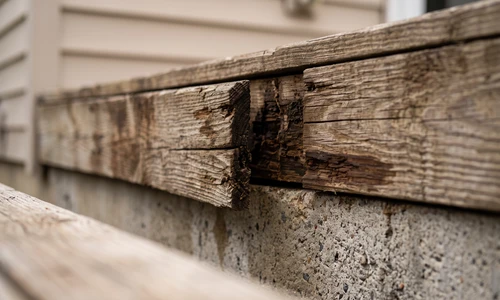
A significant share of deck rot starts not from weather but from how the deck was built. Ledger boards fastened directly against a house rim joist without a moisture barrier or proper flashing trap water at the exact point where the deck meets the home, one of the highest-risk zones on any structure. Joists resting directly on soil instead of concrete footings or posts wick ground moisture continuously. Missing or undersized air gaps beneath deck boards prevent the wood from drying between rain events, so even light, infrequent moisture never fully evaporates before the next exposure.
Why Wood Type Matters: Durability and Fungal Resistance
Not all lumber resists decay fungi equally. Softwoods like pine and fir have looser cell structures that fungi digest more easily, which is why untreated softwood decking rots faster than denser hardwoods like cedar or oak. Pressure-treated lumber contains chemical fungicides injected into the wood fibers, extending service life significantly, but that protection is not permanent. Fungicide concentration diminishes over years of weathering, particularly at cut ends where the treatment never penetrated deeply to begin with. That is why cut ends of pressure-treated boards need field-applied sealant; without it, the untreated interior is exposed directly to moisture.
Climate and Environmental Conditions Accelerating Rot
Wood-decay fungi thrive in warm, humid conditions, generally between 50 and 90 degrees Fahrenheit with wood moisture content above 20 percent. A deck in a coastal or Pacific Northwest climate, with extended wet seasons and persistent humidity, faces a much faster rot timeline than an identical deck built in an arid Southwest climate where wood dries out quickly between rain events.
How Secondary Mechanisms Amplify Decay
Once fungal decay is active, it rarely stays isolated. Softened, decaying wood becomes an easy target for wood-boring insects and carpenter ants, which accelerate structural loss well beyond what fungal decay alone would cause on the same timeline. Fasteners embedded in chemically treated wood can also corrode over time, a reaction between the wood's copper-based preservatives and steel or improperly rated fasteners; as fasteners weaken, boards shift slightly, opening new gaps where water collects. Mold and mildew, meanwhile, are typically the first visible sign that conditions favor deeper fungal colonization.
Essential Equipment and Materials for Deck Rot Inspection
Primary Equipment: What You Actually Need
A flathead screwdriver or an awl is the core diagnostic tool for checking suspected rot. A moisture meter designed for wood gives a more precise reading than the screwdriver test alone and is worth owning if you plan to inspect the deck annually. Beyond that, a flashlight for checking the underside of the structure and a stiff wire brush for clearing debris from joints and connections round out the basic kit.
Consumables and Materials
- Wood hardener or borate-based fungicide treatment for early-stage surface decay
- Exterior-grade wood filler rated for structural gaps, not cosmetic-only fillers
- Penetrating sealant or stain compatible with the deck's existing finish
- Replacement lumber matched to the original species and treatment grade
- Corrosion-resistant fasteners rated for treated lumber contact
If the inspection turns up decay in framing members rather than surface boards, the scope shifts from a weekend materials list to structural work. That is the point where bringing in deck and patio repair professionals saves both time and risk, since load-bearing repairs need to match code requirements for post spacing and joist sizing.
Early Detection: Identifying Rot Before Structural Failure
What are the signs of wood rot in a deck? Early rot appears as soft, spongy wood, dark discoloration, mold, or mildew on the surface. The screwdriver test confirms decay: if a tool easily penetrates the wood with light hand pressure, fungal damage is advanced. Surface discoloration is the point where sealant and fungicide can still arrest further growth.
Professional deck inspectors rely on the screwdriver test as a standard field diagnostic precisely because it is fast and reliable. Press the tip into suspect areas, especially at the ledger board, post bases near ground contact, and anywhere gutters or sprinklers spray the structure directly. Sound wood resists the pressure and the screwdriver bounces back. Decayed wood offers little resistance and the tip sinks in with barely any force.
Prevention: Interrupting the Causation Chain
How to stop wood rot on a deck? Stop rot by addressing its two causes. First, control moisture through proper drainage, grading away from posts, correct flashing at the ledger board, adequate under-deck ventilation, and annual sealant reapplication. Second, limit fungal colonization through appropriate wood selection and pest management. Acting early is far less involved than replacing rotted framing later.
Regular inspection of high-risk areas, the ledger board, ground-contact posts, and drainage zones, can catch moisture problems before fungal colonization ever takes hold. Scheduling annual deck maintenance ahead of the wet season, checking that sealant is intact and that under-deck airflow is unobstructed, keeps the moisture side of the equation in check year after year.
Choosing and Applying Sealants and Fungicide Treatments
Application and Cure Windows
Sealants and stains need a dry substrate to bond correctly, so apply only after at least 48 hours without rain and when wood moisture content reads below 15 percent on a meter. Most penetrating sealants need 24 to 48 hours of cure time before the deck sees foot traffic again, and full water resistance can take up to a week to develop fully. Reapplication timing depends on sun and weather exposure, but most decks need fresh sealant every one to three years to maintain a functional moisture barrier.
Spot Repair vs. Full Board Replacement
Not every case of rot requires tearing out the whole deck. The decision comes down to how deep and how widespread the decay has spread.
- Spot repair makes sense when: decay is limited to the outer layer of one or two boards, the screwdriver test shows resistance just below the surface, and the framing underneath tests solid.
- Full replacement is the right call when: decay has reached load-bearing joists, posts, or the ledger board connection, multiple adjacent boards test soft, or the deck shows visible sagging or movement underfoot.
Special Considerations for Older and Vintage Decks
Decks built before modern building codes tightened flashing and ledger board attachment requirements often carry hidden risk that isn't visible from a surface inspection. Older pressure-treated lumber used different chemical formulations than today's products, some of which have already lost most of their fungicidal protection decades ago. A deck older than 15 to 20 years deserves a full structural inspection, not just a surface check, because the framing members most likely to be compromised, ledger boards and support posts, are also the hardest to inspect without partially disassembling the deck. When a deck's age and hidden connections make a DIY inspection risky or incomplete, exterior repair specialists can evaluate the full structure safely.
Maintenance and Long-Term Care
Can you stop wood rot once it starts? Surface-level rot can often be arrested if fungicide treatment is applied while decay is still shallow and the wood retains most of its density. Once fungi have penetrated deep into structural members like joists or beams, the wood has lost the density and fiber integrity needed to bear load, and removal and replacement become the only reliable solution.
- Inspect the ledger board, post bases, and drainage zones at least once a year, ideally before the wettest season in your climate.
- Reapply sealant or stain on the schedule recommended for your specific product, typically every one to three years.
- Keep gutters and sprinklers directed away from deck surfaces and framing.
- Maintain clear airflow under the deck by removing stored items and vegetation that block ventilation.
- Address any standing water or pooling within days, not weeks.
Things to Consider Before You Start
- Is the decay in a load-bearing member? Posts, beams, and joists carry structural weight, and DIY patching on these components carries real safety risk.
- Do you know the deck's construction history? Decks without permit records or known ledger board attachment details are harder to evaluate accurately without opening up framing.
- Can you access the underside of the deck safely? Many rot problems originate underneath, and inspecting there often means crawling into a tight, low-clearance space.
- Is this a repeated problem in the same spot? Recurring rot at the same location usually points to a moisture pathway that hasn't actually been fixed, not bad luck.
If the honest answers put you on the side of load-bearing damage, unclear history, or a moisture source you can't identify, that's the line where a professional inspection is worth more than another round of surface patching.
Why Homeowners Bring in Ace Handyman Services
- Peace of mind on structural components where a miscalculation risks the safety of the whole deck.
- A one-year labor warranty backing any repair work performed.
- No need to source, learn to use, or return a moisture meter, sealant sprayer, or structural jacks.
- Background-checked, multi-skilled W-2 craftsmen, not short-term contractors, handling the work.
- A predictable weekday timeline that doesn't eat into weekend plans.
- Right-sized scope: a straightforward spot repair gets treated as a spot repair, not upsold into a full rebuild.
- Cleanup included, so old rotted lumber and debris don't become a second project.
If a screwdriver test on your deck's framing raised more questions than it answered, reach out to your local Ace Handyman Services office to get a clear read on what the deck actually needs.
Frequently Asked Questions
What is the typical lifespan of a wooden deck?
A well-maintained pressure-treated wood deck typically lasts 15 to 20 years, while decks left without regular sealant reapplication or drainage upkeep can develop structural rot in as little as 5 to 10 years, especially in humid climates.
What is the difference between wet rot and dry rot on a deck?
Wet rot occurs in wood with consistently high moisture content and tends to stay localized to the wet area. Dry rot, despite the name, still requires initial moisture but can spread into drier surrounding wood through fungal strands, making it more destructive once established.
Why does wood rot faster in certain climates?
Wood-decay fungi thrive between 50 and 90 degrees Fahrenheit with high humidity. Coastal and Pacific Northwest climates with long wet seasons see faster rot progression than arid regions like the Southwest, where wood dries out between rain events before fungal colonization can establish.
Can I paint or seal over rotted wood?
No. Sealant and paint only protect sound wood from future moisture; they do not stop active decay or restore lost structural integrity. Rotted sections need to be treated with fungicide if shallow, or physically removed and replaced if decay has progressed into the wood's core.
How much does it cost to repair a rotting deck board?
Material costs for replacement decking boards vary by species, with pressure-treated lumber generally less expensive than cedar or composite alternatives. The larger cost factor is typically labor and whether the damage extends into structural framing, which requires more extensive work than a surface board swap.
Does composite decking eliminate the risk of rot entirely?
Composite decking resists fungal decay far better than wood since it lacks the organic cellulose fungi need to feed on, but the framing underneath a composite deck is usually still wood and remains just as susceptible to the same moisture-driven rot process.