


A door that sticks in summer and rattles in winter puts you in an uncomfortable spot. Do you call it a quick fix and tighten a hinge, or is the door itself telling you it's done? The stakes are real: repair the wrong door and you're back at this decision in six months; replace a door that only needed hardware and you've spent money you didn't need to spend. This guide walks through the diagnostic logic that separates a repair candidate from a replacement case.
When should you repair vs. replace a door? Repair makes sense when the problem is isolated to hardware, weatherstripping, or minor operational friction and the frame is sound. Replacement makes sense when you see structural cracking, warping through the panel thickness, frame damage, or a pattern of repairs that keeps recurring on the same door within a few years.
Some homeowners work through every diagnostic step below themselves and land on a confident answer. Others get partway through, find a symptom they can't fully interpret, and want a second opinion before committing to a purchase. Ace Handyman Services works with homeowners at either point, whether that means handling the repair itself or confirming that replacement is the right call before you shop for a new door installation and repair project.
Quick Overview: How the Repair vs. Replace Decision Actually Works
- Identify what category the problem falls into: hardware/cosmetic, operational, or structural
- Check the door's age and compare it against expected degradation milestones for its material
- Estimate whether a repair is a durable fix or a temporary patch based on the specific failure
- Look for a cost escalation pattern by counting repairs over the last three years
- Determine whether the diagnosis requires professional tools or eyes, or whether visual inspection is enough
- Weigh non-repair benefits (energy efficiency, security, appearance) if the door is borderline
- Factor in insurance if the damage came from an event like a storm or collision
The Repair vs. Replacement Decision Framework
Before touching a hinge or calling anyone, it helps to organize what you're looking at into three lenses. First, problem type: how is the door actually failing? Second, durability expectation: if you repair this, will it hold for years or months? Third, cost trajectory: is this the first issue with this door, or the third one this year? Every section below maps back to one of these three questions, and by the end you should be able to place your door into a repair or replace category with confidence.
Diagnosing Problem Type: What Your Door Is Actually Telling You
What door problems can be fixed with a simple repair versus requiring replacement? Hardware and cosmetic issues, such as loose hinges or worn weatherstripping, are almost always repairable. Operational failures like sticking or misalignment often resolve with adjustment but sometimes point to a deeper structural cause. True structural damage, including warping, cracking through the panel, or a compromised frame, generally cannot be repaired durably and points toward replacement.
Hardware and Cosmetic Issues (Repair Candidates)
Loose hinges, corroded locksets, worn handles, minor surface scratches, chipped paint, and degraded weatherstripping fall squarely into repair territory. Tightening or replacing hinges typically holds for two to five years before wear resumes. Weatherstripping replacement generally lasts five to seven years, since UV exposure and ozone breakdown are the limiting factors rather than any underlying defect. If your door's problems stop at this list, a repair is the economically sound move almost every time.
Operational Failures (Decision Point: Repair or Deeper Issue?)
Sticking, squeaking, and difficulty latching sit in a gray zone. The diagnostic questions matter here. Does the door stick only at the top, only at the bottom, or along the entire edge? Contact only at the top usually points to frame settling; contact along the whole edge often points to panel warping. Did the symptom appear suddenly or build over weeks? Sudden onset usually means a hardware issue; gradual onset usually means a structural or seasonal cause. Does the problem correlate with humidity or temperature swings? That correlation points to material expansion, which is predictable and sometimes manageable, but it also tells you the door material is reacting to its environment in a way that will likely recur.
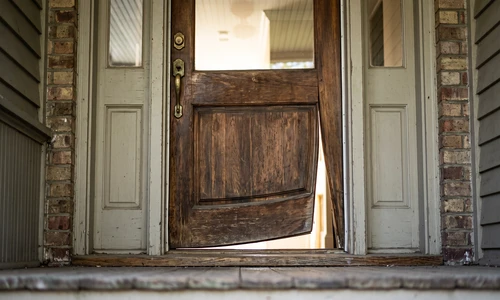
Structural Damage (Replacement Indicators)
Cracked panels, warped frames, and rot from water infiltration resist repair because the underlying material has lost integrity, not just its finish. A crack that runs through the full thickness of a panel creates a permanent weak point; patching the surface does nothing to restore load-bearing strength. A warped frame prevents hinges from holding alignment no matter how many times they're adjusted, because the reference surface itself has shifted. Water that has worked into a door core spreads rot outward over time, so a small soft spot today is a larger structural failure in a year or two. The distinction that matters is depth: cosmetic cracking sits in the paint or veneer layer, while structural cracking runs through the panel itself.
Age-Based Degradation: Understanding Your Door's Remaining Service Life
What is the average lifespan of a door? A residential entry door typically lasts 15 to 30 years depending on material and exposure, while a garage door averages 15 to 20 years. Climate, maintenance frequency, and installation quality can compress or extend these ranges significantly in either direction.
Doors follow a rough age arc. In the first zero to five years, most failures trace back to installation quality or a manufacturing defect rather than wear, and repair is almost always justified since the door itself is still fundamentally sound. From five to ten years, wear starts accelerating, and it's worth noticing whether repairs are clustering around one component, like hinges or the lockset, versus scattering across the whole door. From ten to fifteen years, component failure frequency typically increases and repair costs start climbing. Past fifteen years, the economics usually favor replacement outright, especially once you're paying for a second or third repair on the same unit.
Predicting Repair Durability: Which Fixes Actually Stick?
How do I know if my door repair costs will keep increasing over time? Different repair types carry different durability expectations, and knowing them up front prevents you from budgeting for a permanent fix when you're actually buying a temporary patch. Weatherstripping replacement lasts roughly five to seven years before UV and ozone exposure degrade it again. Hinge tightening and adjustment typically holds two to five years before wear resumes on the same hardware. Hardware replacement (locksets, handles) tends to last a decade or more since these components don't inherently degrade from use the way seals do. Frame shimming or adjustment for a settling foundation usually holds one to three years, because the underlying settling often continues. Climate extremes, how frequently the door is used, and the quality of the original installation all shift these numbers up or down.
Material-Specific Repair and Replacement Patterns
Door material predicts failure mode more reliably than age alone. Wood doors warp from moisture absorption and can rot if water penetrates the core; surface damage is repairable, but core rot signals replacement. Steel doors are vulnerable to rust that spreads from dents or scratched paint; small surface rust spots can be treated and repaired, but rust-through compromises the panel and calls for replacement. Fiberglass doors become brittle under prolonged UV exposure, and small surface cracks are repairable while cracks that run through the full thickness tend to spread and are not.
The Cost Escalation Pattern: When Repairs Stop Making Sense
Doors rarely fail all at once. Individual components wear on staggered timelines: a hinge might fail in year three, weatherstripping in year five, the latch mechanism in year eight. Each individual repair looks reasonable in isolation, but the cumulative pattern is what actually matters. If you've had two or more separate repairs on the same door within the past three years, it's worth projecting forward: what will the next five years likely cost in repairs, and how does that compare to a replacement? As a rule of thumb, once projected repair costs over a five-year window start approaching the bulk of what a new door would run, replacement economics usually win. A well-maintained door shows this escalation slowly; a neglected one accelerates as failures start clustering closer together.
When Professional Evaluation Becomes Essential
How do I know if a door problem needs a professional evaluation instead of my own inspection? Homeowner observation is usually sufficient for hardware wear, cosmetic damage, and obvious weatherstripping deterioration. Professional evaluation becomes necessary for distinguishing cosmetic cracking from structural cracking, checking frame integrity with a level, diagnosing water infiltration patterns, and assessing hinge alignment under load.
Five specific scenarios call for a trained eye rather than a visual guess: distinguishing surface cracking from through-thickness cracking, evaluating whether a frame has settled out of level or square, diagnosing moisture patterns that suggest future rot risk, checking seal and insulation condition where thermal loss isn't obvious to the eye, and assessing hinge binding points under actual door weight and swing. None of these require expensive equipment to check properly, but they do require experience recognizing what a given pattern means. If you recognize any of these scenarios in your own door, a professional assessment can clarify whether a repair will hold or whether replacement genuinely aligns better with your situation.
Choosing and Applying the Right Fix
Once you've landed on repair, sequence matters. Address hardware first (hinges, strike plates, locksets), since a misaligned hinge can masquerade as a deeper structural problem and waste effort if you skip straight to weatherstripping or panel adjustment. Weatherstripping and seal replacement come next, since a properly hung door needs a clean seal to actually perform. Any shimming or frame adjustment should happen last, once you've confirmed the door itself is square and the hardware is functioning, so you're not adjusting around a problem you haven't actually fixed. Give any new weatherstripping a full season to settle before judging its performance, since initial compression and adhesive cure can make it feel tighter or looser than its long-term state.
Simple Hardware Fix vs. Full Door Replacement
Not every symptom demands a full swap. A lighter-touch repair is the right call when the door's core structure is intact and the problem is isolated and diagnosable.
- Choose the lighter repair when the issue is limited to hardware, weatherstripping, or a single misaligned hinge
- Choose the lighter repair when the frame checks out square and free of rot or warping
- Choose the lighter repair when this is the first issue the door has had in several years
Full replacement is the right call in different circumstances.
- Choose replacement when you find structural cracking, through-panel warping, or frame damage
- Choose replacement when repairs have clustered two or more times in the past three years
- Choose replacement when the door is past its expected service life for its material and climate
Special Considerations for Challenging Situations
Storm damage, vehicle impact, and other sudden-event damage change the calculation, since insurance may cover some or all of the replacement cost. Collision damage from a vehicle or falling debris is often covered under homeowner's or auto insurance policies, and weather-related damage from hail or wind varies by policy. Some policies actually favor replacement over repeated repair claims to limit future claim exposure. Document the damage with photos immediately, get evaluations covering both a repair scenario and a replacement scenario, and talk to your adjuster before committing to a path, since claim history can affect future premiums regardless of which route you choose.
Older homes present their own wrinkle: an original door with historic hardware or a nonstandard frame size may not have a straightforward off-the-shelf replacement, which shifts the calculation toward preserving what can be preserved through repair. If you're weighing that trade-off on a period door alongside other exterior projects like siding repair, it's worth getting an assessment before assuming replacement is simpler than it actually is.
Maintenance and Long-Term Care
Extending a door's service life comes down to a short list of habits rather than any single fix.
- Check and lubricate hinges once or twice a year to prevent binding and premature wear
- Inspect weatherstripping annually and replace it at the first sign of compression loss or cracking
- Repaint or reseal wood and fiberglass doors on the manufacturer's recommended cycle to prevent UV and moisture damage
- Watch for early water staining at the bottom corners, since that's where rot typically starts
- Keep hardware tight and address a loose hinge or strike plate as soon as you notice it, before it wears the surrounding wood or frame
Things to Consider Before You Start
Should I replace my door if it's still functional but showing wear? is worth asking honestly before you decide. A door that still closes and locks properly but shows cosmetic wear doesn't need replacement on function alone, though proactive replacement can make sense if you're also chasing energy efficiency or security upgrades.
- Have you actually counted the repairs? Two or more in three years is a real signal, not a coincidence.
- Can you tell cosmetic damage from structural damage? If you're not sure, that uncertainty itself is useful information.
- Is the damage tied to a specific event? Storm or impact damage changes the insurance math.
- Are you weighing non-functional upgrades too? Energy efficiency and security are legitimate reasons to replace a door that still technically works.
By this point you should know which side of the repair-or-replace line your door sits on, or at least know exactly what question still needs a professional answer.
Why Homeowners Bring in Ace Handyman Services
Some repair-vs-replace decisions are straightforward. Others involve a door that's original to the house, a frame that might be more compromised than it looks, or a repair history that's hard to interpret on your own. That's where bringing in a professional set of eyes changes the outcome.
- Peace of mind when the door in question is original, custom-sized, or otherwise hard to replace without a specialty order
- A one-year labor warranty backing the work, whether it's a repair or a full replacement
- No need to source, rent, or return specialty tools for diagnosing frame level or hinge alignment
- Background-checked, multi-skilled W-2 craftsmen, not a rotating cast of subcontractors
- A predictable weekday appointment window instead of losing a weekend to a project that could go sideways
- Honest scoping that recommends the repair when the repair is the right call, not just the bigger job
- Cleanup included once the work is done, so you're not left with old hardware and packaging
If you've worked through the diagnostics above and still aren't sure which side of the line your door falls on, reach out to your local Ace Handyman Services office to get a second opinion before you commit to either path.
When a repair turns out to be bigger than a weekend, request an estimate from Ace Handyman Services and a local, background-checked craftsman will handle it from there.
Frequently Asked Questions
Can I just replace a door without replacing the frame?
Yes, in many cases. Slab-only replacement works when the existing frame is square, free of rot, and properly sized. Frame damage, significant settling, or a frame that's out of square typically forces a full unit replacement, since a new door hung in a compromised frame won't seal or operate correctly.
What is the average cost to replace a door?
Costs vary widely based on material, size, hardware, and whether the frame needs replacing along with the slab. Rather than anchor to a single number, get a scope-specific evaluation, since a hollow-core interior door and a custom exterior unit are entirely different projects.
How long should a typical door repair actually last?
It depends entirely on what's being repaired. Hardware replacement can last a decade or more, weatherstripping typically holds five to seven years, and hinge or frame adjustments tend to need revisiting within two to five years as wear or settling resumes.
Is it ever worth replacing a door that still works fine?
Yes, if you're after benefits beyond basic function, like improved insulation, updated security hardware, or a different aesthetic. These are legitimate reasons to replace proactively, separate from the failure-driven scenarios that force the decision.
Does insurance typically cover door replacement after storm or impact damage?
It depends on your policy and the cause of damage. Vehicle impact and falling debris are often covered under homeowner's or auto policies, while storm coverage varies. Document damage with photos and confirm coverage details with your adjuster before choosing a repair or replacement path.
What's the biggest mistake homeowners make in this decision?
Treating each repair as an isolated event instead of tracking the pattern. A single hinge repair is a minor expense; the same door needing three separate repairs in three years is a signal worth acting on before the next failure shows up.